KalshiTaxes
Kalshi taxes.
Kalshi winnings are taxable, and so are the interest and credits Kalshi pays. As of October 2026, Kalshi’s 1099s cover the interest and credits; none reports your trading profit or loss. There is no IRS guidance on how event contracts are taxed. Of the people we’ve seen file a Kalshi year, three routes are the most common, and below one year runs through all three.
Tax year 2026Checked October 8, 2026Figures from Realize’s tax engine
Kalshi taxes at a glance
Checked October 8, 2026- Reported to the IRS
- Not your profits or losses: “Kalshi does not report profits/losses to the IRS” Source
- What the P&L covers
- Realized profit and loss from closed positions, including fees and any credits or rebates Source
- Incentive credits
- More than $600 in a calendar year is reported to the IRS, and needs an SSN on file Source
What’s taxed
Three kinds of Kalshi income.
Trading results, interest and credits each reach a return a different way, and only two arrive with a form.
Trading. A gain on an event contract is income: the tax code counts “gains derived from dealings in property” as gross income (IRC §61(a)(3)). That holds whether the money stays in your Kalshi balance or is withdrawn. No Kalshi form carries it. Kalshi’s Documents page says so directly: “Kalshi does not report profits/losses to the IRS (the 1099-MISC only contains credit/rewards from Kalshi).” The figure comes from your own trade history, which is what the three routes below work from.
Interest. Kalshi pays interest on cash and open positions. Its help center puts the rate at a variable 3.50%, accruing daily and paid monthly on balances of $250 or more, and says more than $10 of interest a year is reported to the IRS, on a 1099-INT. Interest is ordinary income, and the IRS says taxable interest goes on the return “even if you don’t receive a Form 1099-INT” (IRS Topic 403). It goes on Form 1040 line 2b, with Schedule B once taxable interest passes $1,500.
Credits and rewards. Referral bonuses and liquidity incentives arrive as credits. Kalshi reports them on a 1099-MISC, and its help center says more than $600 of incentive credits in a calendar year is reported to the IRS; the IRS sets the 2026 threshold for other income on a 1099-MISC at $2,000 (1099-MISC instructions). The form’s recipient instructions send box 3, other income, to the “Other income” line of Schedule 1 (Form 1099-MISC).
Crypto. Kalshi describes its 1099-B as covering crypto transfers and its 1099-DA as digital asset reporting from ZeroHash. Each form, its threshold and what it leaves out: what Kalshi’s tax forms cover.
Filing routes
Three ways people file a Kalshi year.
Of the people we’ve seen file a Kalshi year, these are the three most common routes. Each takes the same trades to different forms.
| Standard capital | Section 1256 | Gambling | |
|---|---|---|---|
| Forms | Form 8949 and Schedule D | Form 6781, then Schedule D | Schedule 1 for winnings, Schedule A for losses |
| A gain | Short-term if held a year or less, long-term if longer | 60% long-term and 40% short-term, however long it was held | Ordinary income, with losses kept apart |
| A net loss | Up to $3,000 a year against other income; the rest carries forward | The same $3,000 and carryforward | Only when itemizing, at 90% from 2026, and only up to winnings |
| Open on December 31 | Nothing until it closes | Treated as sold at fair market value on the last business day | Nothing until it settles |
| Carryback | None | A net loss can be carried back three years, by election | None |
Standard capital treats each contract as a capital asset. Each closed position is a row on Form 8949, short-term if it was held a year or less, and the totals go to Schedule D. Net capital losses offset other income up to $3,000 a year ($1,500 married filing separately) under §1211(b), and the rest carries forward under §1212(b).
Section 1256 covers regulated futures contracts and four other named types. Two rules set it apart. Every contract still held at year end is “treated as sold for its fair market value on the last business day” of the year (§1256(a)(1)), and every gain or loss is split 40% short-term and 60% long-term whatever the holding period (§1256(a)(3)). Results go on Form 6781, whose lines 8 and 9 carry the split to Schedule D, and a net Section 1256 loss can be carried back three years under §1212(c).
What people filing this way point to: a regulated futures contract is one traded on a “qualified board or exchange” (§1256(g)(1)), a term that includes “a domestic board of trade designated as a contract market by the Commodity Futures Trading Commission” (§1256(g)(7)(B)), and the CFTC designated KalshiEX LLC a contract market on November 4, 2020. What is cited against it: the section’s list of contract types (§1256(b)(1)) names no event contract, and §1256(b)(2)(B) excludes swaps and any “similar agreement”.
Gambling treats each trade as a wager. Winnings go on Schedule 1 line 8b. Losses come off only as an itemized deduction on Schedule A, and only up to the year’s winnings (IRS Topic 419); from 2026 only 90% of them count. Nothing carries to another year. What is cited against reading Kalshi trades as wagers: a position can be sold on the exchange before the event happens, at a price other traders set rather than odds a bookmaker sets. There is no IRS guidance on how exchange trades group into gambling sessions; Realize’s engine treats every position in one market that closed on one Eastern day as one session.
Worked year
One Kalshi year, worked three ways.
Eight illustrative positions, a single filer with $150,000 of other taxable income, 2026 tax tables and the standard deduction. Every figure comes from Realize’s tax engine.
One year, three routes
| Market | Position | How it ended | Cost | Fees | Result | |
|---|---|---|---|---|---|---|
| A | Fed rate decision | 20,000 NO at $0.80 | Settled NO at $1.00 | $16,000.00 | $224.00 | +$3,776.00 |
| B | NFL game | 30,000 YES at $0.45 | Settled YES at $1.00 | $13,500.00 | $519.75 | +$15,980.25 |
| C | NBA Finals | 12,000 YES at $0.40 | Sold at $0.71 | $4,800.00 | $374.56 | +$3,345.44 |
| D | CPI print | 10,000 NO at $0.70 | Settled NO at $1.00 | $7,000.00 | $147.00 | +$2,853.00 |
| E | Election | 8,000 YES at $0.62 | Settled NO, worth $0.00 | $4,960.00 | $131.94 | −$5,091.94 |
| F | NYC high temperature | 25,000 YES at $0.35 | Settled NO, worth $0.00 | $8,750.00 | $398.13 | −$9,148.13 |
| G | Super Bowl 2027 | 10,000 YES at $0.22 | Open; December 31 close $0.31 | $2,200.00 | $120.12 | +$779.88 at the mark |
| H | A market with no December 31 close | 5,000 YES at $0.50 | Open; no published close | $2,500.00 | $87.50 | None this year |
| Standard capital | Section 1256 | Gambling | |
|---|---|---|---|
| Counted | A to F | A to F, plus G at its December 31 close | A to F, winnings and losses apart |
| Result | +$11,714.62 | +$12,494.50 | $25,954.69 of winnings; $14,240.07 of losses |
| Taxed as | All short-term: each was held under a year | $4,997.80 short-term, $7,496.70 long-term | Winnings as ordinary income, no loss deducted on the standard deduction |
| Federal tax | $2,811.51 | $2,323.98 | $6,229.13 |
| Where it goes | Form 8949 Part I, box C: six rows, then Schedule D | Form 6781 line 1: seven rows; line 8 to Schedule D line 4, line 9 to line 11 | Schedule 1 line 8b: $25,954.69 |
| G next year | Starts from $2,320.12, its cost with the fee | Starts from $3,100.00, its December 31 value | Counted when it settles |
On this year, Section 1256 comes out $487.53 below standard capital: 60% of its gain is taxed at the 15% long-term rate instead of 24%, though it also counts G’s $779.88 mark. Standard capital taxes $11,714.62 at 24%. Under gambling treatment the filer pays tax on all $25,954.69 of winnings, because on the standard deduction none of the $14,240.07 of losses comes off.
For someone who itemizes, 90% of the losses come off on Schedule A line 16: here $12,816.06, with $1,424.01 that never counts. Whether itemizing applies depends on the rest of the return; the IRS explains the choice in Topic 501, Should I itemize?
Losses
Kalshi losses and taxes.
The capital routes deduct up to $3,000 a year and carry the rest; gambling deducts nothing without itemizing. Here, the same year with B settling NO: a $18,285.38 trading loss.
| Standard capital | Section 1256 | Gambling | |
|---|---|---|---|
| Result | −$18,285.38 | −$17,505.50, with G’s +$779.88 mark | $9,974.44 of winnings; $28,259.82 of losses |
| Deducted this year | $3,000.00 | $3,000.00 | Nothing on the standard deduction |
| Federal tax this year | $720.00 lower | $720.00 lower | $2,393.87 on the winnings |
| Carries forward | $15,285.38 | $14,505.50 | Nothing |
| Carryback | None | Can be elected: up to three years back, against Section 1256 gains | None |
The two capital routes give the same deduction this year: $3,000 at 24% is $720.00 (§1211(b)). They differ in what comes next. Under standard capital the rest carries forward to later years (§1212(b)). Under Section 1256 a net loss can instead be carried back three years against Section 1256 gains in those years, by checking box D on Form 6781 and filing Form 1045 or an amended return (Form 6781).
Gambling treatment works differently in a losing year. Winning sessions are still income, so this filer pays $2,393.87 of tax on $9,974.44 of winnings with nothing deducted. Itemizing would let losses offset winnings, never more, and what is left over does not carry to another year (IRS Topic 419). For people who lost money, what a losing year can be worth goes further.
2026 change
The 90% limit on gambling losses.
From 2026, a gambling loss is only partly deductible, even against winnings.
Public Law 119-21 (§70114) rewrote §165(d). For taxable years beginning after December 31, 2025, the deduction for wagering losses “shall be equal to 90 percent of the amount of such losses” and “shall be allowed only to the extent of the gains from such transactions” (IRC §165(d)(1)).
So someone who wins and loses the same amount pays tax on 10% of it. In the worked year, an itemizing filer with $14,240.07 of losses deducts $12,816.06 and pays tax on $1,424.01 of losses that never come off. The limit belongs to the gambling route only; standard capital and Section 1256 net losses against gains in full.
IRS Topic 419, checked October 8, 2026, still describes losses as deductible up to the amount of winnings and does not mention the 90% limit. The statute is the current text.
Year end
Positions open on December 31.
Only one of the three routes counts a position before it closes.
For people filing under Section 1256, every contract still held at the close of the year is treated as sold at fair market value on the last business day (§1256(a)(1)). In 2026 that is Thursday, December 31. The gain or loss counts that year, and §1256(a)(2) adjusts the later sale so it is not counted twice, which makes the year-end price the new starting point.
In the worked year, G cost $2,320.12 with its fee and closed December 31 at $0.31, so its 10,000 contracts are marked at $3,100.00: a $779.88 gain on Form 6781. Next year G starts from $3,100.00. Under standard capital and gambling treatment, G counts nothing until it settles or is sold.
Kalshi’s 1099s cover interest, credits and crypto transfers, not your trades, and its P&L statement covers closed positions only, with no December 31 price for anything still open. Realize reads that price from the daily close Kalshi publishes for each market. More on what Kalshi’s tax forms cover.
H shows the other case. When Kalshi published no close for a market on December 31, Realize’s engine has no price to mark it at, so H stays off Form 6781 rather than being deemed sold at a figure nobody traded. It counts when it closes.
Fees and records
Fees sit inside Kalshi’s net.
What Kalshi’s own figures already include, and what to watch when rebuilding a year from its data.
Kalshi charges a trading fee on each fill and nothing at settlement (Kalshi fees). Its Documents page says its P&L figures “reflect realized profit and loss from your closed positions, including fees and any credits or rebates you’ve received”, and shows the year with and without fees.
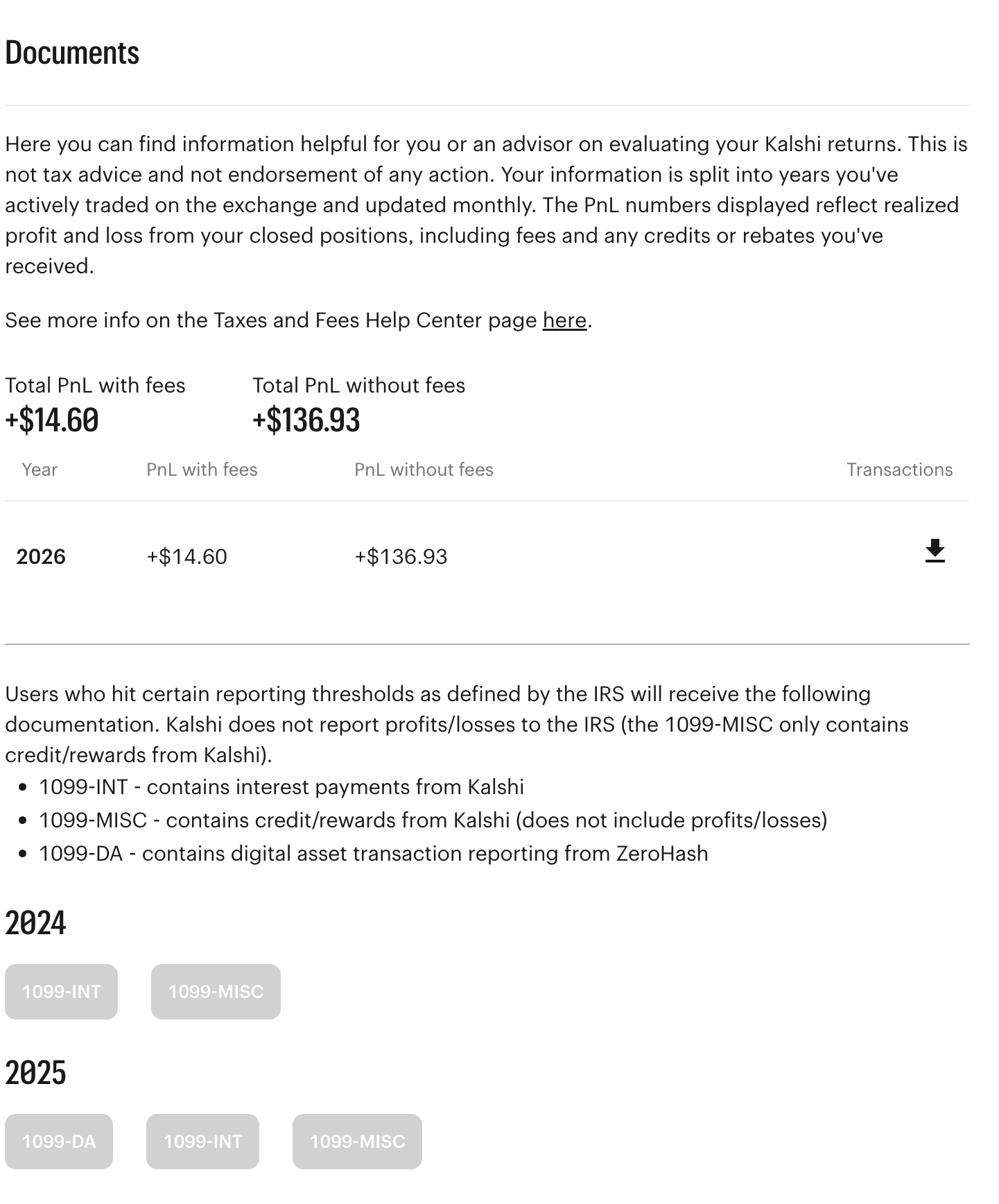
On that account, 2026 shows +$14.60 with fees and +$136.93 without: $122.33 of fees in the year so far. Realize’s engine subtracts fees on every route, so each position’s result is proceeds minus cost minus fees, as in the worked year.
- A settlement is a sale at the payout. A contract that settles at $0.00, like E and F, is a sale for $0.00: a loss on the standard capital and Section 1256 forms.
- Kalshi computes P&L first in, first out, which is also how Realize matches lots.
- Credits sit inside the Documents page totals but are not trading results; they arrive on the 1099-MISC.
- Fills before Kalshi’s historical cutoff come only from a separate historical endpoint, so a year read from the live endpoint alone can come up short.
For each year, the records every route is computed from: Kalshi’s full trade and settlement history, any 1099s it sends, and your deposits and withdrawals. Whether Kalshi is legal where you live is a separate question from how it is taxed (is Kalshi legal in my state?).
- What the P&L covers
- Realized profit and loss from closed positions, including fees and any credits or rebates Source
- P&L statement
- Yearly, first in first out; the help center says it updates the first morning of each month Source
- Fill history
- Fills before a moving historical cutoff are served only by GET /historical/fills; the live window’s length is not published Source
State tax
State income tax.
Every figure on this page is federal.
Each state with an income tax applies its own rules to the same trading, interest and credit income. Texas and Florida levy no personal income tax: the Texas Constitution bars a tax on the net incomes of individuals, and the Florida Constitution limits a tax on residents’ income to what federal law would credit, which Florida does not levy.
Estimate
Try your own number.
Enter your Kalshi net for the year and see three common routes side by side.
The step-by-step filing walkthrough lives in how to file a Kalshi year. Realize also offers a call with our team for anyone who wants one.
Questions
Questions people ask.
- Are Kalshi winnings taxable?
- Yes. Gains on event contracts are income under IRC §61, whether or not a form arrives. Kalshi says it does not report profits or losses to the IRS, so the figure comes from your own trade history.
- Does Kalshi send a 1099?
- Only above reporting thresholds, and not for your trades. Kalshi’s help center says it reports more than $10 of interest and more than $600 of incentive credits a year. It lists a 1099-INT for interest, a 1099-MISC for credits and rewards, a 1099-B for crypto transfers and a 1099-DA for digital asset reporting through ZeroHash.
- Can I deduct Kalshi losses?
- It depends on the route. Under standard capital or Section 1256, net losses offset up to $3,000 of other income a year and the rest carries forward, and a net Section 1256 loss can be carried back three years. Under gambling treatment, from 2026, 90% of losses can be deducted, only when itemizing and only up to winnings.
- What happens to Kalshi positions open on December 31?
- Under Section 1256 they are treated as sold at fair market value on the last business day of the year, and that price becomes the starting point for the eventual sale. Under standard capital and gambling treatment they count only when they close.
- Is Kalshi interest taxable?
- Yes. Interest is ordinary income. Kalshi reports more than $10 a year to the IRS on a 1099-INT, and the IRS says taxable interest goes on the return even without the form.
- Is there IRS guidance on how Kalshi trades are taxed?
- No. No IRS notice, ruling or regulation addresses event contracts. Of the people we’ve seen file a Kalshi year, standard capital, Section 1256 and gambling treatment are the three most common routes.
Sources24 documents
Where each fact comes from.
Every figure above links to one of these, read on the date shown.
- Kalshi Help Center: What tax documentation does Kalshi provide? Checked October 8, 2026
- Kalshi account Documents page (logged in) Checked October 8, 2026
- Kalshi Help Center: How to add your Social Security Number Checked October 8, 2026
- CFTC Designates KalshiEX LLC as a Contract Market Checked October 8, 2026
- Kalshi Help Center: APY on Kalshi Checked October 8, 2026
- Kalshi Fee Schedule (PDF), effective July 7, 2026 Checked October 8, 2026
- Kalshi API docs: Get Fills Checked October 8, 2026
- Kalshi API docs: Historical Data Checked October 8, 2026
- IRC §61, gross income defined (Cornell LII) Checked October 8, 2026
- IRC §1256, section 1256 contracts (Cornell LII) Checked October 8, 2026
- IRC §1211, limitation on capital losses (Cornell LII) Checked October 8, 2026
- IRC §1212, capital loss carrybacks and carryovers (Cornell LII) Checked October 8, 2026
- IRC §165(d), wagering losses (Cornell LII) Checked October 8, 2026
- Public Law 119-21, §70114 (govinfo) Checked October 8, 2026
- IRS Form 6781 and its instructions Checked October 8, 2026
- IRS Instructions for Form 8949 Checked October 8, 2026
- IRS Topic No. 419, Gambling income and losses Checked October 8, 2026
- IRS Topic No. 403, Interest received Checked October 8, 2026
- IRS Topic No. 501, Should I itemize? Checked October 8, 2026
- IRS: About Schedule B (Form 1040) Checked October 8, 2026
- IRS Form 1099-MISC, instructions for recipient Checked October 8, 2026
- Instructions for Forms 1099-MISC and 1099-NEC (2026) Checked October 8, 2026
- Texas Constitution, article VIII, §24-a (Texas Legislative Council) Checked October 8, 2026
- Florida Constitution, article VII, §5 Checked October 8, 2026
Also on Realize
The rest of the Kalshi record.
What Kalshi sends you, what it charges, and the filing walkthrough.
Price your Kalshi year three common ways.
Connect Kalshi read-only for a free estimate under each treatment.