KalshiTax forms
Kalshi tax forms: four 1099s, and none reports your trades.
As of October 8, 2026, Kalshi sends up to four tax forms, each only above an IRS reporting threshold: a 1099-INT for interest, a 1099-MISC for credits and rewards, a 1099-B for crypto transfers and a 1099-DA through ZeroHash. None reports your trades, and its P&L statement covers closed positions only.
Checked October 8, 2026From Kalshi’s own pages and the IRS
Kalshi tax forms at a glance
Checked October 8, 2026Reporting
Does Kalshi report your trades to the IRS?
No. Kalshi’s Documents page, where its tax documents sit in the app, says it plainly: “Kalshi does not report profits/losses to the IRS (the 1099-MISC only contains credit/rewards from Kalshi).” Its help center lists four forms: Form 1099-INT for interest, 1099-MISC for credits and rewards, 1099-B for “transaction proceeds from broker transactions (crypto transfers)” and 1099-DA for digital asset reporting from ZeroHash. Each goes only to members who cross an IRS reporting threshold.
For trading, Kalshi provides a profit and loss statement, computed first in, first out and, in Kalshi’s words, updated monthly, that reflects “realized profit and loss from your closed positions.” A contract still open on December 31 is not on it, at any price. Section 1256 treats each contract held at year end as sold at fair market value on the last business day of the year (26 U.S.C. §1256(a)(1)), so people filing that way need a year-end price the statement does not carry. Kalshi’s daily price history carries one for any market that traded that day: the day closes at its last traded YES price.
Realize pulls your full Kalshi history from its API: every fill, including the ones Kalshi has archived, every settlement, and the exchange’s published daily closes, December 31 included. That covers what each common filing route needs, so you can file the way that suits you.
Which forms
Which forms will I get?
Kalshi’s and the IRS’s published thresholds, applied to your answers.
Forms for tax year 2026
- 1099-INTNot expectedInterest payments from Kalshi. Kalshi reports more than $10 of interest in a year.
- 1099-MISCNot expectedCredit/rewards from Kalshi. More than $600 in Kalshi’s words; the IRS line for 2026 is $2,000.
- 1099-DANot expectedDigital asset transaction reporting from ZeroHash. Kalshi publishes no dollar line for it.
- 1099-BNot expectedCrypto transfers. Listed in the help center, not on the in-app Documents page.
- Your tradesNo form“Kalshi does not report profits/losses to the IRS.” Kalshi’s P&L statement shows realized profit and loss from closed positions, including fees and any credits or rebates.
| Form | In Kalshi’s words | Sent above |
|---|---|---|
| 1099-INT | “Interest payments from Kalshi” | More than $10 of interest in a year |
| 1099-MISC | “Credit/rewards from Kalshi (does not include profits/losses)” | More than $600 of credits, per Kalshi. IRS line: $600 for 2025, $2,000 for 2026 |
| 1099-B | “Transaction proceeds from broker transactions (crypto transfers)” | Not published |
| 1099-DA | “Digital asset transaction reporting from ZeroHash” | Not published |
| Your trades | No form. Kalshi’s P&L statement is not a tax form. | |
Kalshi gives its thresholds in its Social Security Number article: more than $10 of interest a year, and more than $600 of incentive credits such as referral bonuses, with referral and liquidity incentive credits counted together. At the 3.50% variable rate Kalshi pays on balances of $250 or more, about $286 held for a full year earns $10.
The IRS line for a 1099-INT is $10 (IRS instructions). For a 1099-MISC it was $600 through tax year 2025; for tax years beginning after 2025 the IRS instructions set it at $2,000, adjusted for inflation from 2027. Kalshi’s help center still says $600. Kalshi publishes no dollar line for its 1099-B or 1099-DA.
P&L statement
What the P&L statement covers.
The one place Kalshi shows a trading figure, and it is not a tax form.
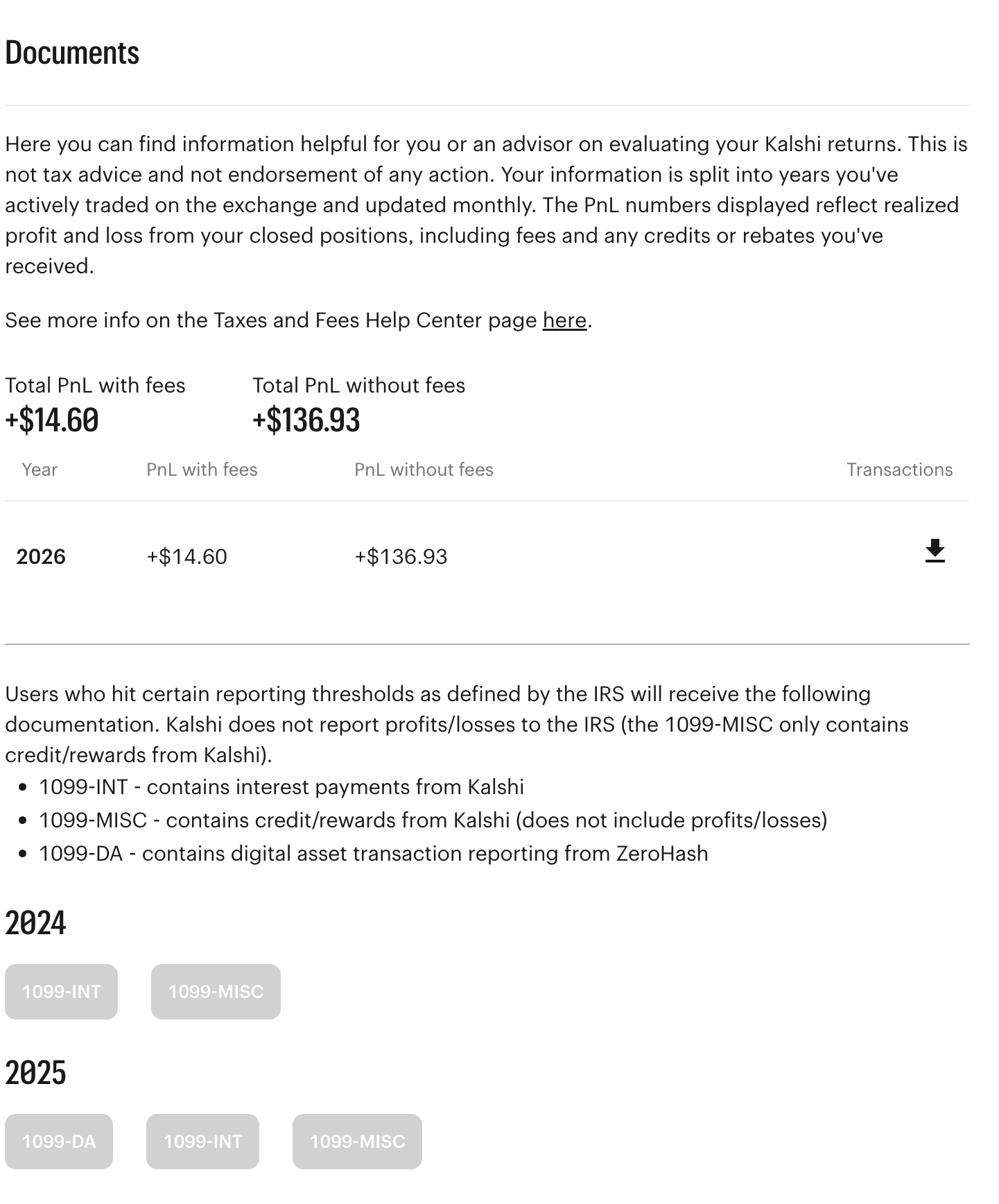
The Documents page splits the statement by year into two figures, PnL with fees and PnL without fees, each with a download of that year’s transactions. On the account in the capture above, 2026 reads +$14.60 with fees and +$136.93 without, a gap of $122.33. Kalshi’s help center says the figure is computed first in, first out.
The download is a zip holding one CSV, named for the year’s dates (realized_pnl_2026-01-01_2027-01-01.csv), with 13 columns: one row per closed lot, with entry and exit prices, open and close fees, and profit with and without fees, plus a row for each credit, with no ticker and its amount as the profit. Contract counts can be fractional, and the rows sum to the two figures on the page. The help center says the statement updates on the first morning of each month; the 2026 download on October 8, 2026 already held closes from that morning.
Three things follow from Kalshi’s own wording.
- Closed positions only. A position open on December 31 is not in that year’s figure, at any price, and nothing on the statement or the forms gives it a year-end value.
- Credits sit inside the figure. The help center says the figure “includes fees and any rebates”; the Documents page says “fees and any credits or rebates.” A credit over the 1099-MISC threshold is therefore on the 1099-MISC and also inside the P&L total; the CSV lists it as its own row.
- The API shows trades, not credits. No endpoint in Kalshi’s API returns credits or interest, so a figure rebuilt from the API, ours included, is trading only and reads below Kalshi’s headline by the credits. On one account we measured, the rebuilt figure was −$181.92 against a headline of −$171.93 that included a $10 credit.
- P&L statement
- Yearly, first in first out; the help center says it updates the first morning of each month Source
- What the P&L covers
- Realized profit and loss from closed positions, including fees and any credits or rebates Source
- P&L download
- A zip of one CSV, realized_pnl_<start>_<end>.csv: one row per closed lot, plus a row for each credit Source
- Daily price history
- A public daily candlestick for each market, closing at its last traded YES price Source
On the return
Where the trading figure goes without a 1099-B.
Each common route has a line for trades no form reported.
There is no IRS guidance on whether event contracts are Section 1256 contracts. Of the people we’ve seen file, three routes are the most common, and each has a place for trades no broker reported.
- For people filing under Section 1256, Form 6781 line 1 takes box 11 of each 1099-B, and its instructions say to “list separately each transaction for which you didn’t receive a Form 1099-B or substitute statement.” For Kalshi trades, that is every one. Boxes 8 to 11 of a 1099-B are where a broker reports profit or loss on regulated futures and Section 1256 contracts (IRS instructions). Form 6781 for event contracts walks through the form.
- For people filing as standard capital, Form 8949 box C (short-term) and box F (long-term) are for transactions “not reported to you on Form 1099-B or Form 1099-DA.” Standard capital treatment covers the rows.
- For people reporting the year as gambling, winnings go on Schedule 1 and losses come off on Schedule A only for those who itemize. Kalshi lists no W-2G among its forms.
Income is taxable whether or not a form reports it: the tax code counts “all income from whatever source derived” (26 U.S.C. §61). The same year under each route, in dollars, is in the Section 1256 60/40 rule.
Finding them
Where Kalshi’s tax documents are, and what an empty page means.
In the app, the forms sit under each year on a page labelled Documents in the account menu, at kalshi.com/account/taxes. Kalshi’s help center calls the same place “the Account tab under the Tax Info page,” and its trading history article calls it “the documents tab.” No Tax Info label appears in the app as of October 8, 2026. Some forms also arrive by email from Zenwork, Kalshi’s tax form provider.
If no form appears, Kalshi says it is likely because no IRS threshold was met. That covers interest, credits and crypto, and says nothing about whether the year’s trading made or lost money. Kalshi uses a Social Security Number for this reporting and does not need one to deposit, trade or withdraw by non-crypto methods.

- Social Security Number
- Used for tax reporting; not needed to deposit, trade or withdraw by non-crypto methods Source
By tax year
What changes from 2025 to 2026.
- The 1099-MISC line rises from $600 to $2,000 for tax years beginning after 2025, adjusted for inflation from 2027. Kalshi’s help center still gives $600, so for 2026 credits between the two the help center and the IRS instructions point different ways.
- The account in the capture above received a 1099-DA for 2025. For 2026 the IRS instructions make gross proceeds reporting mandatory for all digital assets, and basis reporting mandatory for those that are covered securities.
- Perpetual futures trade through Kalshi Prime, a futures commission merchant separate from Kalshi’s prediction market exchange, and Kalshi’s tax article does not mention them. This page covers event contracts.
FAQ
Kalshi tax forms, answered.
Does Kalshi send a 1099?
Yes, but not for your trades. Kalshi sends a 1099-INT for interest, a 1099-MISC for credits and rewards, a 1099-B for crypto transfers and a 1099-DA through ZeroHash, each only to members above an IRS reporting threshold. No Kalshi 1099 reports the profit or loss on event contracts.
Does Kalshi report my profits to the IRS?
No. Kalshi’s Documents page says “Kalshi does not report profits/losses to the IRS.” Its 1099-INT covers interest, its 1099-MISC credits and rewards, its 1099-B crypto transfers and its 1099-DA digital assets through ZeroHash. Its P&L statement shows realized profit and loss from closed positions, and it is not a tax form.
Is the Kalshi 1099-B for my trades?
No. Kalshi describes its 1099-B as “transaction proceeds from broker transactions (crypto transfers).” A broker reports profit or loss on regulated futures and Section 1256 contracts in boxes 8 to 11 of a 1099-B; Kalshi does not describe its form as covering them.
Why didn’t I get a 1099 from Kalshi?
Kalshi sends its forms only to members who cross an IRS reporting threshold: more than $10 of interest, more than $600 of credits in Kalshi’s words (the IRS line is $2,000 from tax year 2026), or crypto activity. An empty page says nothing about whether you made or lost money trading.
Where do I find my Kalshi tax forms?
On the Documents page in Kalshi’s account menu (kalshi.com/account/taxes), listed by year. Kalshi’s help center still calls it Tax Info. Some forms also arrive by email from Zenwork, Kalshi’s tax form provider.
Sources16 documents
Where each fact comes from.
Every figure above links to one of these, read on the date shown.
- Kalshi account Documents page (logged in) Checked October 8, 2026
- Kalshi Help Center: What tax documentation does Kalshi provide? Checked October 8, 2026
- Kalshi Help Center: Your perpetuals margin account Checked October 8, 2026
- Kalshi Help Center: How to add your Social Security Number Checked October 8, 2026
- Kalshi Help Center: APY on Kalshi Checked October 8, 2026
- Kalshi Help Center: Liquidity Incentive Program Checked October 8, 2026
- Kalshi Help Center: Crypto deposits Checked October 8, 2026
- Kalshi API docs: Get Market Candlesticks Checked October 8, 2026
- Kalshi Help Center: Trading history Checked October 8, 2026
- IRS: Instructions for Forms 1099-MISC and 1099-NEC Checked October 8, 2026
- IRS: Instructions for Forms 1099-INT and 1099-OID Checked October 8, 2026
- IRS: Instructions for Form 1099-B (2026) Checked October 8, 2026
- IRS: Form 6781 (2025), with its instructions Checked October 8, 2026
- IRS: Form 8949 (2025) Checked October 8, 2026
- 26 U.S.C. §1256: Section 1256 contracts marked to market Checked October 8, 2026
- 26 U.S.C. §61: Gross income defined Checked October 8, 2026
Also on Realize
The rest of the Kalshi record.
Fees, a quick estimate, and the long walkthrough.
Get your Kalshi tax forms.
Connect Kalshi read-only and Realize builds the forms from your full trade history.