KalshiPolymarket USCompare
Kalshi vs Polymarket: taxes, fees and data.
Kalshi and Polymarket US are both CFTC-designated exchanges, and as of October 8, 2026 they differ most at tax time. Kalshi issues 1099-INT, 1099-MISC, 1099-B and 1099-DA, none showing your trading profit or loss; Polymarket US’s documentation has no tax section. A taker pays $1.75 on Kalshi and $1.74 on Polymarket US for 100 contracts at 50¢.
By Owen Monagan, Founder & CEOUpdated Realize connects to both
Side by side
Checked October 8, 2026Which Polymarket
Is Polymarket US the same as polymarket.com?
Polymarket sells two products under one name, and only one of them is a US exchange.
Kalshi is one exchange: KalshiEX LLC, which the CFTC designated a contract market on November 4, 2020. Polymarket is two products. Polymarket US is run by QCX LLC, which the CFTC designated a contract market on July 9, 2025 (order), and its trades clear through QC Clearing LLC, which does business as Polymarket Clearing. On November 24, 2025 an amended order removed the original order’s bar on futures commission merchants carrying customer accounts there.
The other product is polymarket.com, which Polymarket’s own documentation calls its “international, crypto-based product that operates on blockchain technology”. It keeps different records from Polymarket US, and much of what is written about “Polymarket taxes” describes wallets and crypto settlement that a Polymarket US account does not have. Everything below about Polymarket means Polymarket US.
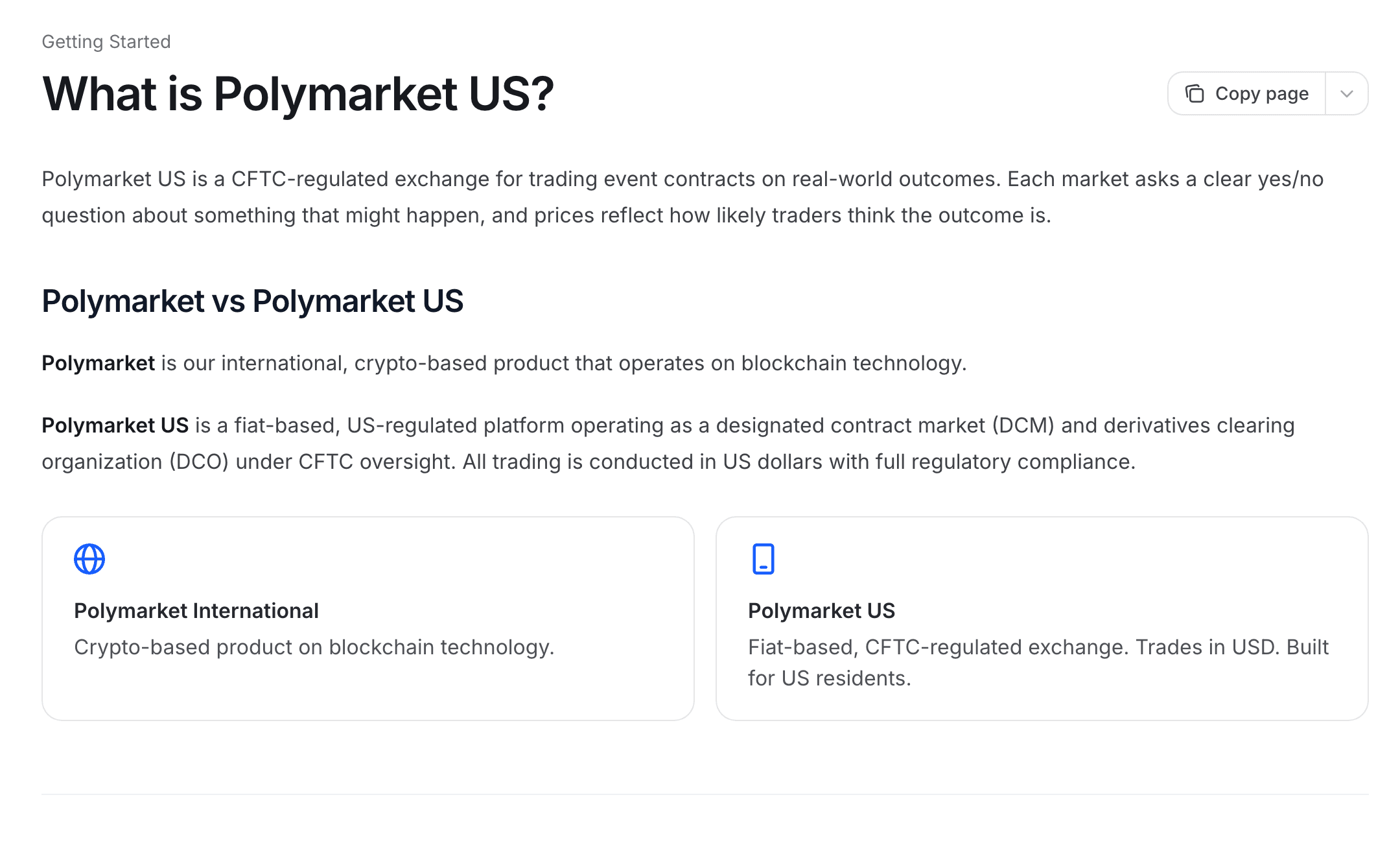
Realize connects to Kalshi and to Polymarket US and builds tax forms from either; it does not support polymarket.com. Neither exchange reviewed this page.
Side by side
Polymarket vs Kalshi, line by line.
Each cell is the exchange’s own document, read on the date at the top of the page.
| Kalshi | Polymarket US | |
|---|---|---|
| Operator | KalshiEX LLC | QCX LLC d/b/a Polymarket US |
| CFTC status | A contract market by the CFTC on November 4, 2020 | A contract market by the CFTC on July 9, 2025 |
| Social Security Number | Used for tax reporting; not needed to deposit, trade or withdraw by non-crypto methods | Collected at signup; identity checks come before any deposit or trade |
| Tax forms | 1099-INT, 1099-MISC, 1099-B, 1099-DA | None documented: no page of the docs mentions a 1099, a W-9 or the IRS |
| Trading profit or loss on a form | No form reports it | No form documented |
| Yearly statement | Yearly, first in first out; the help center says it updates the first morning of each month | None described: the portfolio shows cash, open positions and account value |
| Trade export | Your activity page: All time to Custom dates, saving Kalshi-Recent-Activity-All.csv with 25 columns of orders, trades, settlements, deposits, withdrawals and credits | Documented for the institutional API, with a historical floor of May 1, 2026 |
| API history | Fills before a moving historical cutoff are served only by GET /historical/fills; the live window’s length is not published | GET /v1/portfolio/activities: trades, position resolutions, deposits, withdrawals, rebates and transfers |
| Fee on each fill | Kalshi’s API reports the fee on every fill as fee_cost, in fixed-point dollars | Price, quantity, isAggressor, cost basis and realized P&L; no fee field in the published schema |
| Taker fee | round up(M x 0.07 x C x P x (1-P)) | 0.0695 x C x p x (1 - p), at most $1.74 per 100 contracts at 50¢ |
| Resting orders | 1 for takers and 0 for makers, unless a series is listed with its own | 0.0125 x C x p x (1 - p) paid to the resting order, at most $0.31 per 100 at 50¢ |
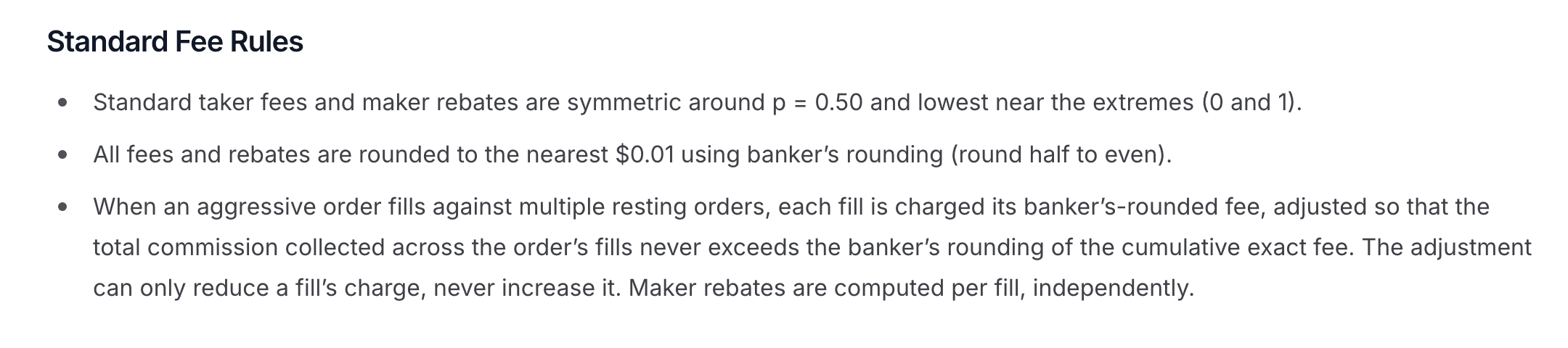
| Rounding | Up, so the fee plus the position cost lands on a centicent | To the nearest $0.01 by banker’s rounding (round half to even) |
| Settlement | No fee | No fee listed |
| Deposits and withdrawals | ACH: No fee to deposit or withdraw. Debit card deposit: Up to 2% | No fee listed for any method |
| Daily price history | A public daily candlestick for each market, closing at its last traded YES price | Public, keyed by market slug: book-derived Yes and No display prices, not trades |
| API keys | Ed25519, recommended and selected by default, or RSA 2048 for RSA-PSS clients | Ed25519, created at polymarket.us/developer after identity checks; no read-only scope described |
Fee calculator
The same order on both exchanges.
Pick a price and a number of contracts to see each exchange’s fee, rounded the way each schedule rounds.
Kalshi
$1.75
Polymarket US
$1.74
A gap of $0.01 on this order. A negative figure is a rebate paid to you.
Fees
Two formulas, one coefficient apart.
Both exchanges charge a share of P x (1-P). The coefficients, the rounding and the treatment of resting orders differ.
Kalshi’s fee schedule charges a taker round up(0.07 x C x P x (1-P)), where C is the number of contracts and P the price in dollars. Polymarket US’s fee schedule, effective October 1, 2026, charges 0.0695 x C x p x (1 - p). The coefficient is 0.0005 lower, so at 1,000 contracts at 50¢ the fees are $17.50 and $17.38. Both curves peak at 50¢ and are symmetric around it.
The rounding is where small orders part ways. Kalshi rounds up to the cent, so a single contract always costs at least 1¢. Polymarket US rounds to the nearest cent by banker’s rounding, so a fee under half a cent rounds to nothing: one contract at 1¢ costs $0.01 on Kalshi and $0.00 on Polymarket US, and one at 25¢ costs $0.02 and $0.01.
| Price | Kalshi, 1 | Polymarket US, 1 | Kalshi, 100 | Polymarket US, 100 |
|---|---|---|---|---|
| 1¢ | $0.01 | $0.00 | $0.07 | $0.07 |
| 5¢ | $0.01 | $0.00 | $0.34 | $0.33 |
| 10¢ | $0.01 | $0.01 | $0.63 | $0.63 |
| 25¢ | $0.02 | $0.01 | $1.32 | $1.30 |
| 50¢ | $0.02 | $0.02 | $1.75 | $1.74 |
| 75¢ | $0.02 | $0.01 | $1.32 | $1.30 |
| 90¢ | $0.01 | $0.01 | $0.63 | $0.63 |
| 99¢ | $0.01 | $0.00 | $0.07 | $0.07 |
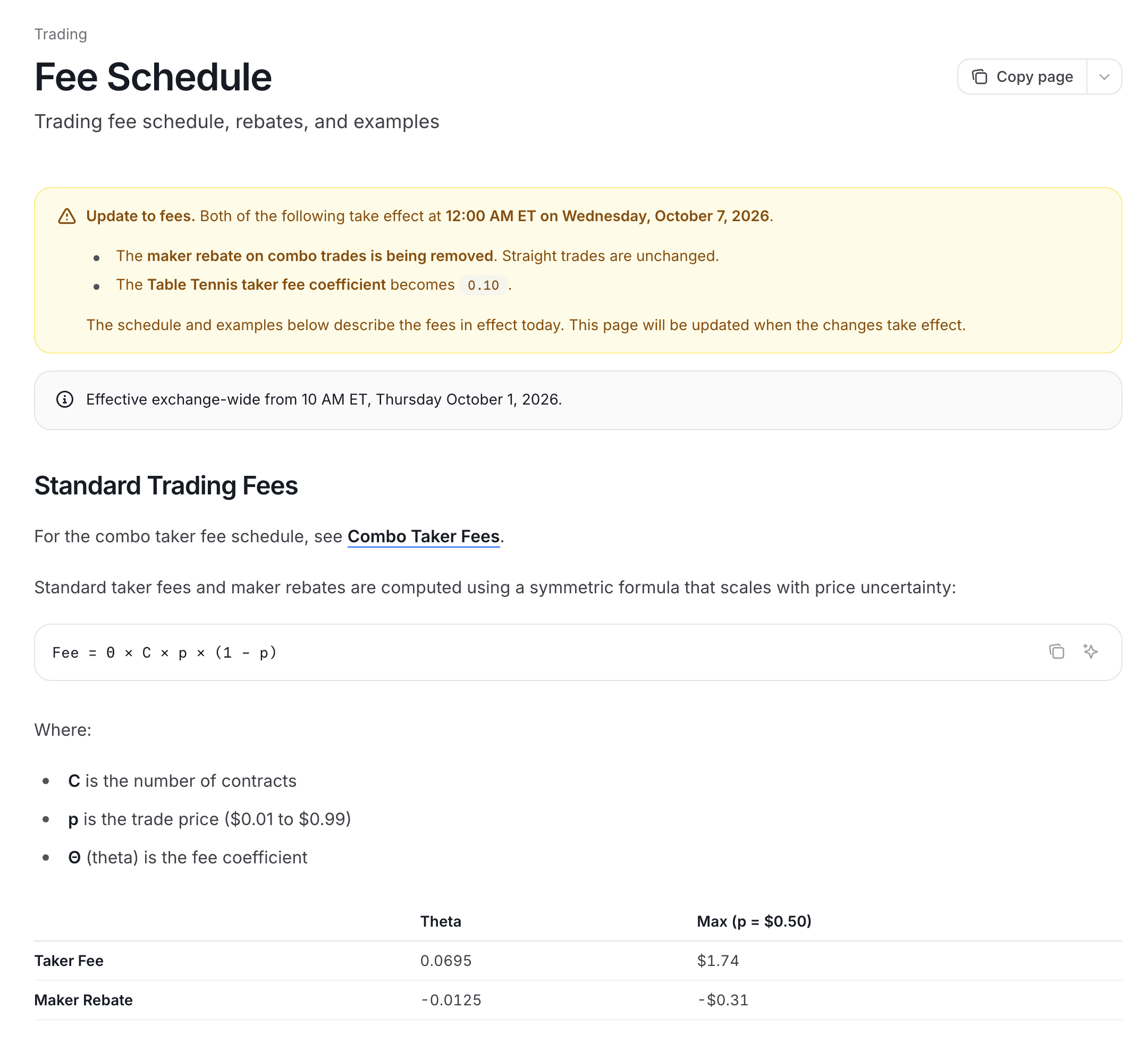
Resting orders are treated in opposite directions. Kalshi’s maker multiplier defaults to 0, so a resting order in most markets pays nothing; the series its schedule lists charge round up(0.0175 x C x P x (1-P)), $0.44 on 100 contracts at 50¢, and combos charge makers half the taker fee. Polymarket US’s fee page lists a maker rebate of 0.0125 x C x p x (1 - p), paid to the resting order: −$0.31 on 100 contracts at 50¢.
That rebate is in flux. On October 8, 2026 the fee page still carried a notice that from October 7 combos lose the maker rebate and table tennis takes a 0.10 taker coefficient, and said the page “will be updated when the changes take effect”. Polymarket US’s filing with the CFTC on October 2 dates the combo change ten business days after certification, and a second filing that day would pay maker rebates only to participants with $10 million or more of maker volume in the prior month. The combo taker formula on the fee page uses 0.06 x (1 - p)^4; the September 29 notice filed 0.04. The figures here are the ones the fee page lists.
Neither exchange lists a settlement fee. Kalshi charges nothing for bank transfers and up to 2% on debit card deposits; Polymarket US’s funding pages list methods, limits and timing and no fee. Polymarket US pays high-volume takers a share of their fees back, from 10% above $250,000 a month, and a third October 2 filing would move those rebates to five tiers from 3% to 30%. Kalshi publishes no volume discount for event contracts.
- Combos, per the fee page
- C x p x [0.0695 x (1 - p) + 0.06 x (1 - p)^4], on the combo as a whole Source
- Combo maker filing
- No maker rebate on combo fills, effective ten business days after certification Source
- Maker rebate filing
- No maker rebate under $10 million of prior-month maker volume, tiered above it, effective ten business days after certification Source
- Volume rebate filing
- 3%, 5%, 10%, 15% or 30% of taker fees from $250,000, $1 million, $10 million, $25 million or $50 million a month, effective ten business days after certification Source
Tax forms
What tax forms do Kalshi and Polymarket US send?
Kalshi documents four forms, none with your trading result. Polymarket US documents none.
Kalshi’s help center lists a 1099-INT for interest, a 1099-MISC for credits and rewards, a 1099-B for crypto transfers and a 1099-DA from ZeroHash, each sent only when an IRS threshold is crossed. None reports what you made or lost on event contracts, and its Documents page says “Kalshi does not report profits/losses to the IRS”. Kalshi tax forms covers each form and its threshold.
Polymarket US has not documented any form. On October 8, 2026 its documentation ran to 322 pages, and none mentioned a 1099, a W-9 or the IRS; there is no tax section in its help pages. The one primary document that names a form is its customer agreement, where you “consent to the electronic delivery of all tax forms, including, without limitation, IRS Form 1099-B”. That sets how a form would be delivered. It does not say one will be sent, or what it would show.
The two also differ on Social Security Numbers. Polymarket US collects one at signup, before any deposit or trade. Kalshi says it uses the number for tax reporting and does not need it to deposit, trade or withdraw by non-crypto methods.
- Customer agreement
- Consent to electronic delivery of “all tax forms, including, without limitation, IRS Form 1099-B” Source
Trade data
Getting your trades out.
With neither exchange reporting your result, the figure comes from your own trade record.
Kalshi gives app users two downloads: an activity CSV of every order, trade, settlement, deposit and withdrawal, and a yearly profit and loss file with one row per closed lot. Its API splits fills at a moving cutoff, so a full year needs both the live and the historical endpoints. Kalshi trade history covers each column.
Polymarket US documents no export for app users; its portfolio page shows cash, open positions and account value. Its retail API serves your history through GET /v1/portfolio/activities: trades, position resolutions, deposits, withdrawals, rebates and transfers, signed with an Ed25519 key you create at polymarket.us/developer. The CSV trade, position and fee reports documented in its reporting guide are documented for the institutional API, and serve nothing before May 1, 2026. Its changelog says execution records are kept for 7 days, and that the pruning left trades and positions unchanged.
The published trade schema has no fee field and no side. On the fills Realize reads from a connected account, each trade carries the commission it paid, or the rebate it earned, in an execution object the schema leaves out, and its price is always the Yes price, so a No order at 55¢ was filled at 45¢. Realize separates the commission from the trade’s cash flow so cost, proceeds and fee each stand alone.
For a position still open on December 31, the year-end price comes from each exchange’s public history. Kalshi’s daily candlestick closes at the last traded Yes price. Polymarket US’s price history is “book-derived” display prices, “not individual trades”; Realize takes the midpoint of its Yes and No prices at Eastern midnight. A market with no price that day is left off Form 6781 rather than marked at an invented number.
- Activity API
- GET /v1/portfolio/activities: trades, position resolutions, deposits, withdrawals, rebates and transfers Source
- Each trade
- Price, quantity, isAggressor, cost basis and realized P&L; no fee field in the published schema Source
- API keys
- Ed25519, created at polymarket.us/developer after identity checks; no read-only scope described Source
- Execution records
- Kept 7 days from July 16, 2026; the pruning left trades and positions unchanged Source
Filing routes
The same three routes reach both.
How each route works does not depend on the exchange. What one route relies on does.
There is no IRS guidance on how event contracts are taxed. Of the people we’ve seen file, three routes are the most common, and each works the same way for Kalshi and Polymarket US trades:
- Standard capital reports each closed position on Form 8949 and Schedule D, short or long term by holding period. A net loss can offset up to $3,000 of other income a year, with the rest carried forward (§1211(b), §1212(b)).
- Section 1256 reports the year on Form 6781: 60% of the net is taxed as long term and 40% as short term whatever the holding period, and positions open on December 31 are treated as sold at that day’s price (§1256(a)). A net loss can be carried back three years (§1212(c)).
- Gambling reports winnings on Schedule 1, and losses come off only as an itemized deduction, up to the year’s winnings; from 2026 only 90% of them count (§165(d), IRS Topic 419).
Where the exchange matters is Section 1256. People filing that way point to §1256(g)(7)(B), which counts as a qualified board or exchange “a domestic board of trade designated as a contract market by the Commodity Futures Trading Commission”. The CFTC designated KalshiEX LLC on November 4, 2020 and QCX LLC, Polymarket US, on July 9, 2025. The designation belongs to Polymarket US, not to polymarket.com. What is cited against the route applies to both exchanges alike: the section’s list of contract types (§1256(b)(1)) names no event contract, and §1256(b)(2)(B) excludes swaps and any “similar agreement”. Kalshi taxes works one year through all three routes.
Trading both
One return, two ledgers.
Trades on both exchanges go on the same return, and each keeps its own record.
A year on both exchanges is one year on the return. Of the people we’ve seen file one, the Kalshi and Polymarket US trades go under one route, land on the same forms and net the way that route nets: on Form 8949 and Schedule D, on Form 6781, or as one year of winnings and losses. A loss on one exchange and a gain on the other meet on the same form.
What stays separate is the record behind it. Each exchange’s fills carry its own fees and its own rounding, and under Section 1256 each position open on December 31 takes its own exchange’s price for that day. Kalshi’s records start with its downloads; Polymarket US’s start with its API. Realize connects to both, rebuilds each from its fills, and builds one set of forms from the two.
Questions
Questions people ask.
- Is Polymarket US the same as polymarket.com?
- No. Polymarket’s documentation calls polymarket.com its “international, crypto-based product that operates on blockchain technology”, and Polymarket US a fiat-based exchange regulated by the CFTC, where all trading is in US dollars. They are separate accounts with separate records. Realize connects to Polymarket US and does not support polymarket.com.
- Are Kalshi and Polymarket regulated in the US?
- Both run CFTC-designated contract markets. The CFTC designated KalshiEX LLC on November 4, 2020 and QCX LLC, which does business as Polymarket US, on July 9, 2025. Polymarket US trades clear through QC Clearing LLC, a CFTC-registered clearing organization. The international polymarket.com is a different product.
- Does Polymarket send a 1099?
- Polymarket US has not documented one. On October 8, 2026, none of the pages in its documentation mentioned a 1099, a W-9 or the IRS. Its customer agreement asks you to consent to receiving “all tax forms, including, without limitation, IRS Form 1099-B” electronically, which says how a form would arrive, not that one will.
- Does Kalshi send a 1099?
- Kalshi lists four: 1099-INT for interest, 1099-MISC for credits and rewards, 1099-B for crypto transfers and 1099-DA from ZeroHash, each only above an IRS threshold. None of them reports your profit or loss on event contracts, and Kalshi’s Documents page says “Kalshi does not report profits/losses to the IRS”.
- How do Kalshi and Polymarket US fees compare?
- On a straight trade the two taker formulas differ by 0.0005 in the coefficient: 100 contracts at 50¢ cost $1.75 on Kalshi and $1.74 on Polymarket US. Rounding moves small orders further apart: one contract at 1¢ costs $0.01 on Kalshi and $0.00 on Polymarket US. A resting order pays nothing in most Kalshi markets, while Polymarket US’s fee page lists a rebate of −$0.31 on 100 contracts at 50¢.
- Are Kalshi and Polymarket taxed the same way?
- Each of the three routes people most often use, standard capital, Section 1256 and gambling, works the same way for trades on either exchange. Both are CFTC-designated contract markets, which is the point people filing under Section 1256 rely on.
- Can I download my Polymarket US trade history for taxes?
- Polymarket US documents no export for app users. Its retail API serves your trades, resolutions, deposits and withdrawals, and the CSV reports in its docs are documented for the institutional API, with nothing before May 1, 2026. Kalshi offers an activity CSV and a yearly profit and loss download.
- I traded on both. Do I report them together?
- Trades on both exchanges go on the same return. Of the people we’ve seen file a year on both, the two exchanges’ trades go under one route, and each exchange’s positions open on December 31 take that exchange’s own price for that day under Section 1256, and Realize connects to both and builds one set of forms from the two.
- Is trading income taxable if neither exchange sent a form?
- Gross income includes gains “from whatever source derived” (IRC §61), whether or not a form reports them. Neither Kalshi’s forms nor anything Polymarket US has documented reports trading profit or loss, so the figure comes from your own trade records.
Sources38 documents
Where each fact comes from.
Every figure above links to one of these, read on the date shown.
- CFTC Designates KalshiEX LLC as a Contract Market Checked October 8, 2026
- Kalshi Help Center: How is Kalshi regulated? Checked October 8, 2026
- Kalshi Help Center: What tax documentation does Kalshi provide? Checked October 8, 2026
- Kalshi account Documents page (logged in) Checked October 8, 2026
- Kalshi Help Center: How to add your Social Security Number Checked October 8, 2026
- Kalshi account: Your activity (signed in) Checked October 8, 2026
- Kalshi API docs: Historical Data Checked October 8, 2026
- Kalshi API docs: Get Fills Checked October 8, 2026
- Kalshi API docs: API Keys Checked October 8, 2026
- Kalshi Fee Schedule (PDF), effective July 7, 2026 Checked October 8, 2026
- Kalshi: Fee schedule Checked October 8, 2026
- Kalshi API docs: Get Market Candlesticks Checked October 8, 2026
- CFTC Industry Filings: QCX LLC d/b/a Polymarket US (DCM) Checked October 8, 2026
- CFTC Order of Designation, QCX LLC (July 9, 2025) Checked October 8, 2026
- CFTC Amended Order of Designation, Polymarket US (November 24, 2025) Checked October 8, 2026
- CFTC registry: Derivatives Clearing Organizations Checked October 8, 2026
- Polymarket US docs: What is Polymarket US? Checked October 8, 2026
- Polymarket US documentation, every page (sitemap) Checked October 8, 2026
- Polymarket US Individual Participant and Clearing Member Agreement (August 6, 2026) Checked October 8, 2026
- Polymarket US docs: Create an Account Checked October 8, 2026
- Polymarket US docs: Your Portfolio Checked October 8, 2026
- Polymarket US API docs: Get Activities Checked October 8, 2026
- Polymarket US API docs: Authentication Checked October 8, 2026
- Polymarket US docs: Reporting Checked October 8, 2026
- Polymarket US docs: Changelog Checked October 8, 2026
- Polymarket US API docs: Get Price History Checked October 8, 2026
- Polymarket US docs: Fee Schedule Checked October 8, 2026
- Polymarket US Exchange Notice: Weekly Notification of Fee Schedule Change (September 29, 2026) Checked October 8, 2026
- Polymarket US Exchange Notice: Maker Rebate on Combination Contracts (October 2, 2026) Checked October 8, 2026
- Polymarket US Exchange Notice: Amendment to Maker Rebate (October 2, 2026) Checked October 8, 2026
- Polymarket US Exchange Notice: Amendment to Tiered Taker Fee Rebate (October 2, 2026) Checked October 8, 2026
- Polymarket US docs: Fund Your Account Checked October 8, 2026
- IRC §61, gross income defined (Cornell LII) Checked October 8, 2026
- IRC §1256, section 1256 contracts (Cornell LII) Checked October 8, 2026
- IRC §1211, limitation on capital losses (Cornell LII) Checked October 8, 2026
- IRC §1212, capital loss carrybacks and carryovers (Cornell LII) Checked October 8, 2026
- IRC §165(d), wagering losses (Cornell LII) Checked October 8, 2026
- IRS Topic No. 419, Gambling income and losses Checked October 8, 2026
Also on Realize
More on each exchange.
The Kalshi record in depth, and a quick estimate for a Polymarket US year.
Price your year three common ways.
Connect Kalshi, Polymarket US or both read-only for a free estimate under each treatment.