KalshiOrders
How each way of trading on Kalshi changes your fee.
On Kalshi the fee is paid by the order that takes. In most markets a limit order that rests on the book and fills later pays nothing; series with maker fees, such as NFL games, charge it a quarter of the taker fee, MLB games charge half the usual fee on both sides, and combos charge makers half. The same 100 contracts previewed $17.99 bought at the ask and $16.00 resting at the bid, though a resting order may never fill. From Kalshi’s fee schedule, effective July 7, 2026, and its order ticket, checked October 8, 2026.
By Owen Monagan, Founder & CEOUpdated Schedule effective July 7, 2026
Kalshi orders at a glance
Checked October 8, 2026- Resting order only
- A box that blocks a limit priced to match at once, so the order can only rest Source
Scenarios
One position, five ways in and out.
Buy and sell the same contracts as a taker, as a maker, or hold them to settlement, and see the fees side by side.
Between $0.00 and $3.36 in fees on this position, depending on how each order fills.
| Way in and out | Total | ||
|---|---|---|---|
| Taker in, taker outBuy at the ask, sell at the bid | $1.68 | $1.68 | $3.36Baseline |
| Taker in, held to settlementBuy at the ask, no sale | $1.68 | No sale | $1.68$1.68 less |
| Maker in, taker outA resting buy, then a sale at the bid | $0.00 | $1.68 | $1.68$1.68 less |
| Maker in, maker outA resting buy and a resting sale | $0.00 | $0.00 | $0.00$3.36 less |
| Maker in, held to settlementA resting buy, no sale | $0.00 | No sale | $0.00$3.36 less |
Fees if each order fills at these prices. A resting order may fill later or not at all, and a position held to settlement pays $1 or nothing, with no fee. Computed from Kalshi’s fee schedule effective July 7, 2026; MLB games at the multiplier of 0.5 their order ticket shows.
Every figure comes from the formula in Kalshi’s fee schedule, rounded to the cent the way its own fee table rounds, and matches the previews Kalshi’s order ticket showed on October 8, 2026: $0.44 resting and $1.73 taking on 100 contracts in an NFL game, $0.22 and $0.88 in an MLB game, and $0.00 resting in a market without maker fees. Fees on one position are also on Kalshi fees, with the calculator for any single order.
Makers and takers
Kalshi maker vs taker fees: who pays.
The order that matches one already on the book pays. The order that was waiting there usually does not.
Kalshi’s fee schedule says trading fees “are only charged for orders that are immediately matched with orders sitting on the orderbook”. That order is the taker. The order it matched, which was resting on the book, is the maker, and it pays only in the series the schedule lists under maker fees. Both use the same formula, round up(M x rate x C x P x (1-P)), with a rate of 0.07 for takers and 0.0175, a quarter of that, for makers. M is 1 for takers and 0 for makers unless a series sets its own.
| Market | Taker | Maker |
|---|---|---|
| Most markets | $1.75 | $0.00 |
| Maker-fee series, such as NFL games | $1.75 | $0.44 |
| MLB games | $0.88 | $0.22 |
| Combos | $1.75 | $0.88 |
On the same Nobel Peace Prize contract, with the ask at 17¢ and the bid at 16¢, the order ticket previewed $17.99 for 100 contracts bought at the ask and $16.00 for 100 resting at the bid. The $1.99 between them is $1.00 of price, the 1¢ spread, and $0.99 of fee.
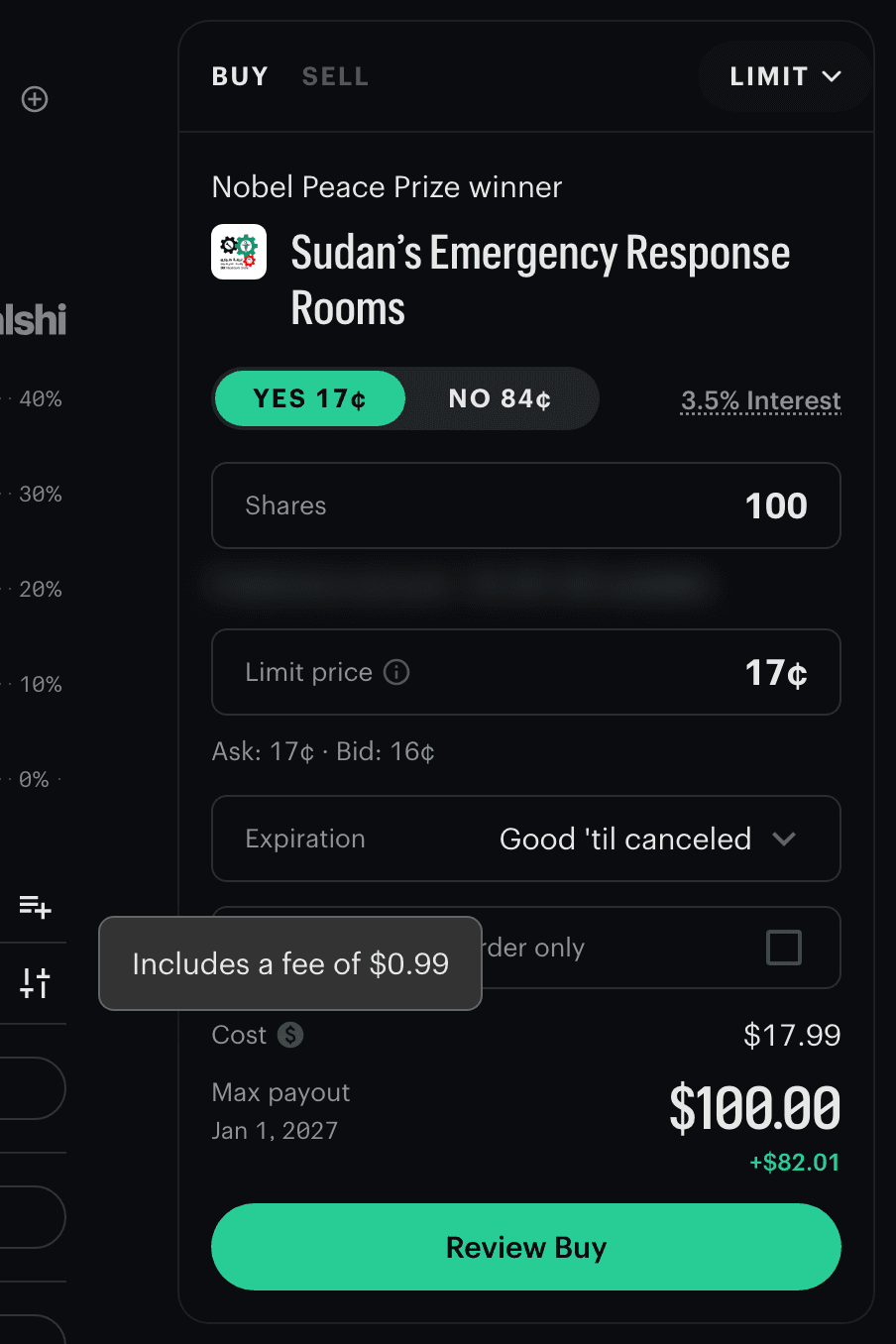
At the 17¢ ask: $17.99
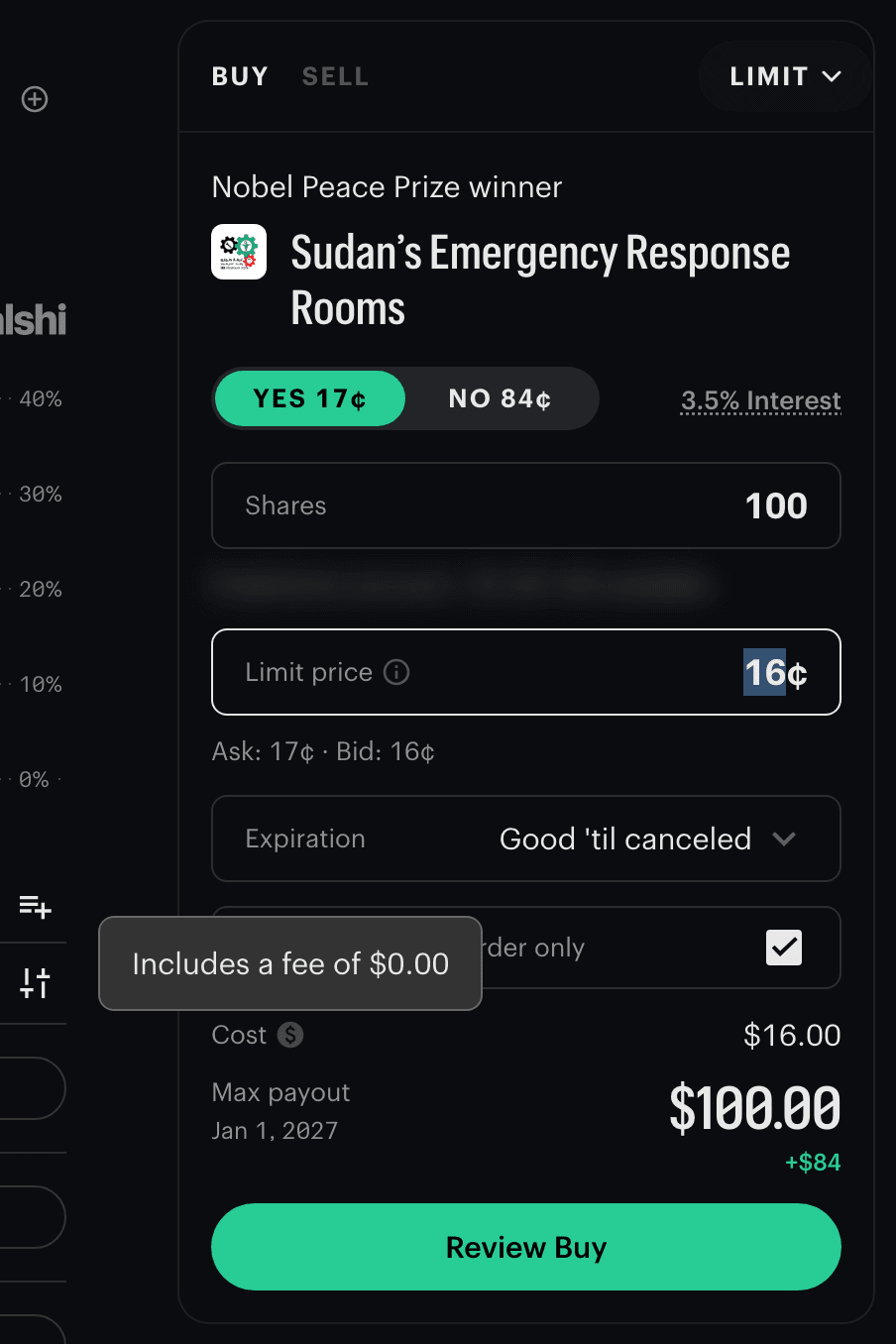
Resting at the 16¢ bid: $16.00
- When charged
- On orders matched immediately. A resting order pays only in a series with maker fees, and only when it executes; cancelling costs nothing. Source
- NFL games (KXNFLGAME)
- Maker and taker multiplier 1, so a resting order pays a quarter of the taker fee Source
- MLB games (KXMLBGAME)
- Multiplier 0.5 since August 7, 2026; the order ticket previews both the taker and the maker fee at half Source
Dollars and Shares
Buying at the market: Dollars or Shares.
Kalshi’s ticket has no mode called Market. DOLLARS and SHARES are its market orders, and both take.
- What it costs
The taker fee, always: both modes buy from orders already on the book. $10 in DOLLARS at 17¢ bought 55.58 contracts and showed “Includes a fee of $0.55”. 100 in SHARES at an average price of 17¢ showed Cost $17.99, “Includes a fee of $0.99”.
- How to place it
- Open the market and pick YES or NO; each button shows its price.
- Open the dropdown at the top right of the ticket and choose DOLLARS or SHARES.
- Enter an amount in Dollars or a number of contracts in Shares.
- Hover the $ icon beside Odds or Cost to read “Includes a fee of $…”, then Review Buy.
- The difference
This is the baseline the other ways are measured against: the full taker fee, at whatever price the book offers.
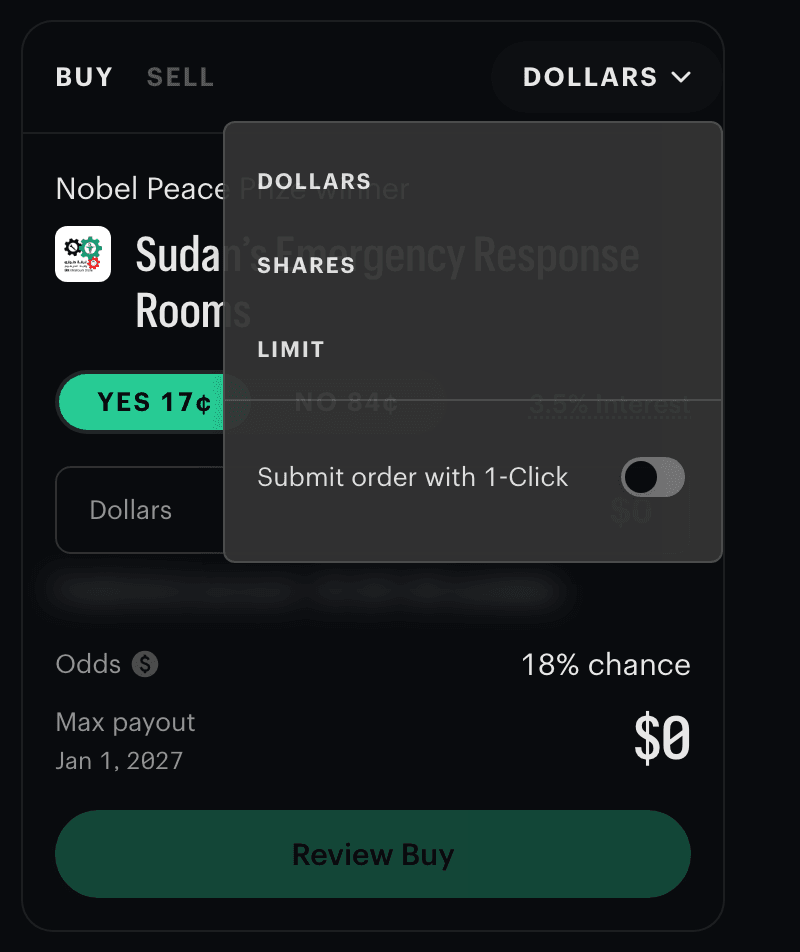
The mode dropdown
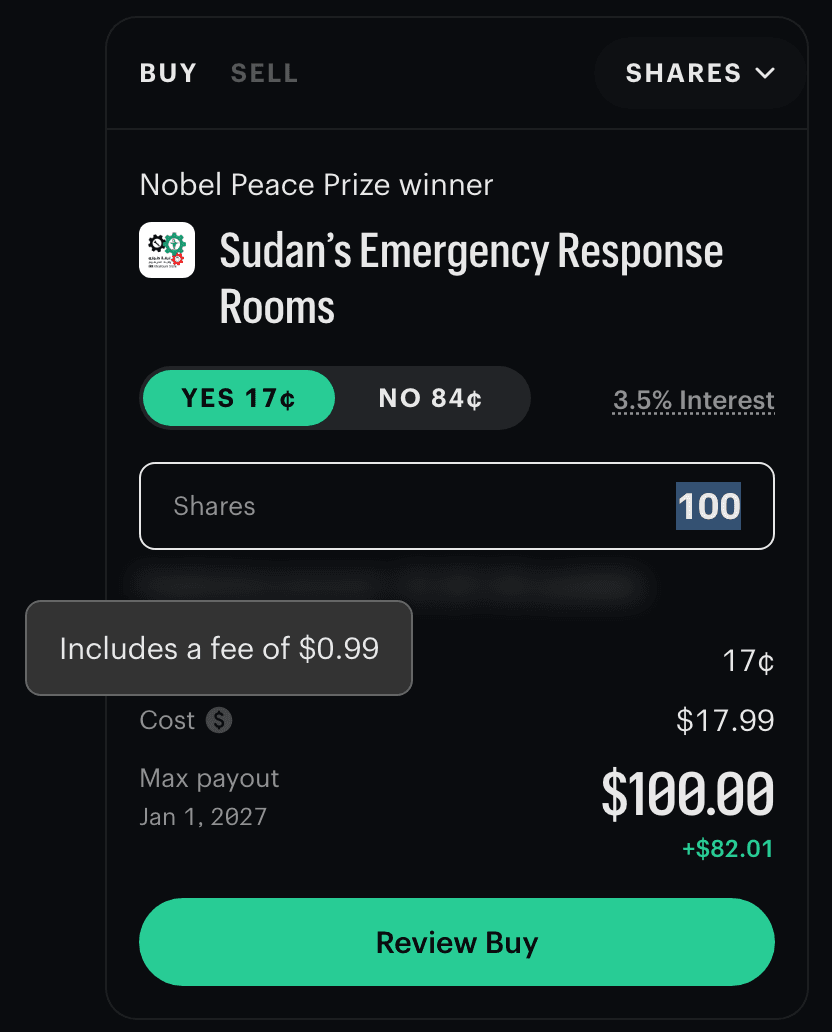
SHARES: 100 at 17¢
- Order ticket
- DOLLARS, SHARES or LIMIT, with a Submit order with 1-Click toggle; no mode is called Market Source
Limit at the ask
A Kalshi limit order at the ask.
The ticket fills in the limit price with the ask, so an untouched limit order is a taker order.
- What it costs
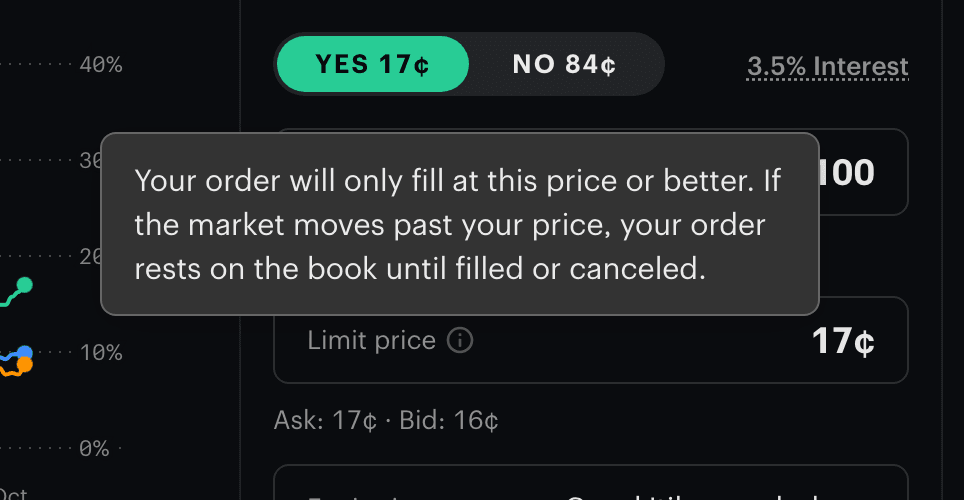
The same taker fee, at a price you cap. The tooltip beside Limit price reads: “Your order will only fill at this price or better. If the market moves past your price, your order rests on the book until filled or canceled.” Priced at the ask, it fills at once.
- How to place it
- Choose LIMIT in the dropdown.
- Enter a number in Shares.
- Leave Limit price as filled in. On a buy it is the ask, shown on the line below as “Ask: 17¢ · Bid: 16¢”.
- Read Cost, which includes the fee, then Review Buy.
- The difference
None against SHARES: both previewed $17.99 for 100 contracts at 17¢. The limit only differs if the price moves before the order reaches the book, when it rests at its limit price rather than filling at the new one.
Resting limit
A resting limit order.
A buy priced at or below the bid, or a sale at or above the ask, rests on the book until someone takes it. The ticket’s resting-only box works much like the post_only flag in Kalshi’s API.
- What it costs
The maker fee, and only when it fills: nothing in most markets, a quarter of the taker fee in series such as NFL games, and an eighth of the usual taker fee in MLB games. Cancelling it costs nothing.
- How to place it
- Choose LIMIT and enter Shares.
- Set Limit price at or below the Bid on the line under it to buy (16¢ here), or at or above the Ask to sell.
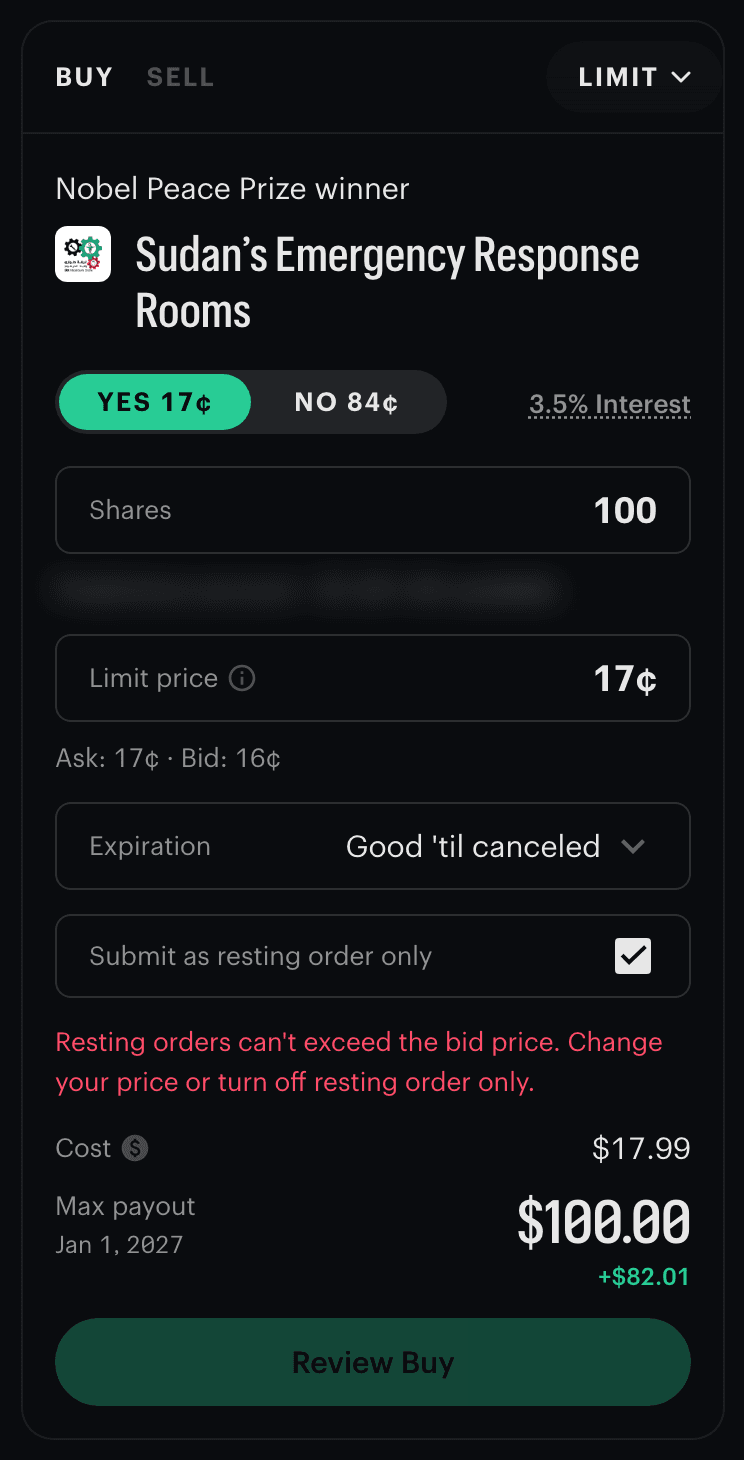
- Tick Submit as resting order only. The ticket then refuses a buy priced above the bid.
- Check that Cost shows no fee in a market without maker fees, then Review Buy.
- The difference
$1.99 on 100 contracts in the Nobel market: $1.00 of spread and $0.99 of fee. A resting buy fills only when someone sells to it, which happens when the price comes down to it, so it may fill as the market moves against it, or not at all. Kalshi’s help center says a limit order is not guaranteed to fill.
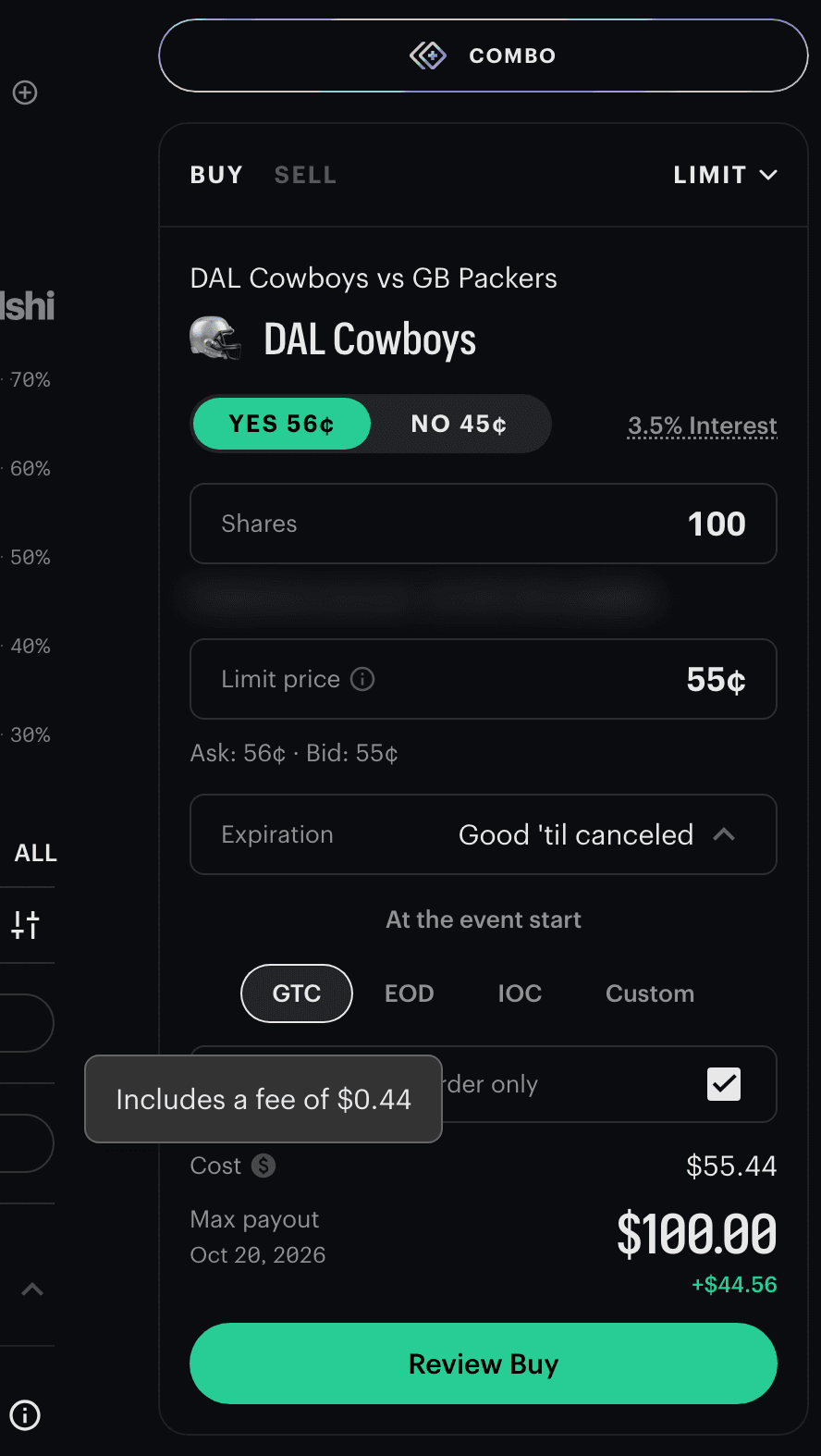
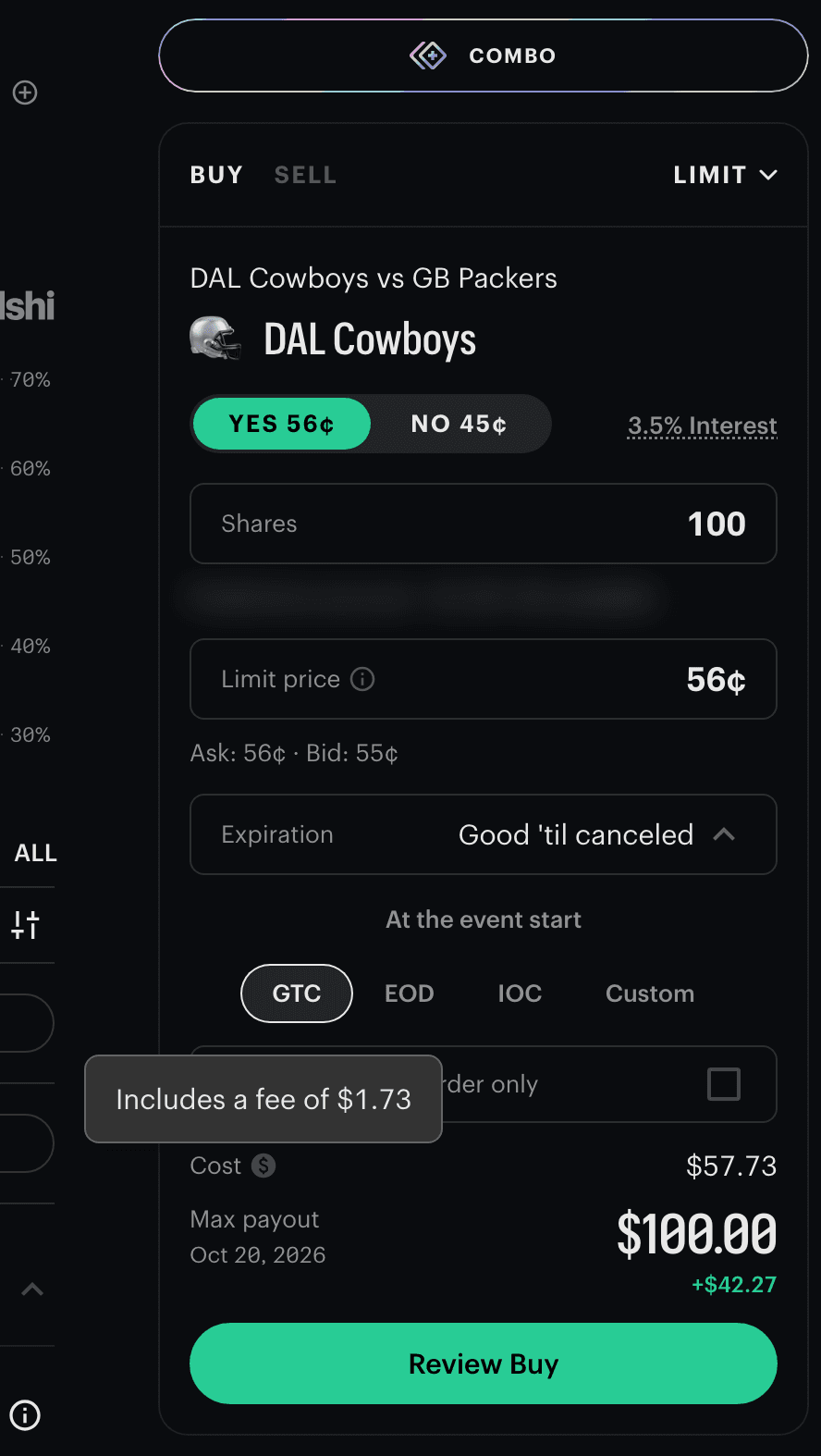
With Submit as resting order only ticked and the price left at the 17¢ ask, the ticket shows “Resting orders can't exceed the bid price. Change your price or turn off resting order only.” and disables Review Buy. In a series with maker fees, the resting fee shows in the preview: on an NFL game, 100 contracts cost $57.73 at the 56¢ ask, including $1.73 of fee, and $55.44 resting at the 55¢ bid, including $0.44. On an MLB game, at half the multiplier, $0.88 at the 53¢ ask and $0.22 at the 51¢ bid.
Resting only, priced at the ask
NFL game, resting at 55¢: $0.44
NFL game, at the 56¢ ask: $1.73
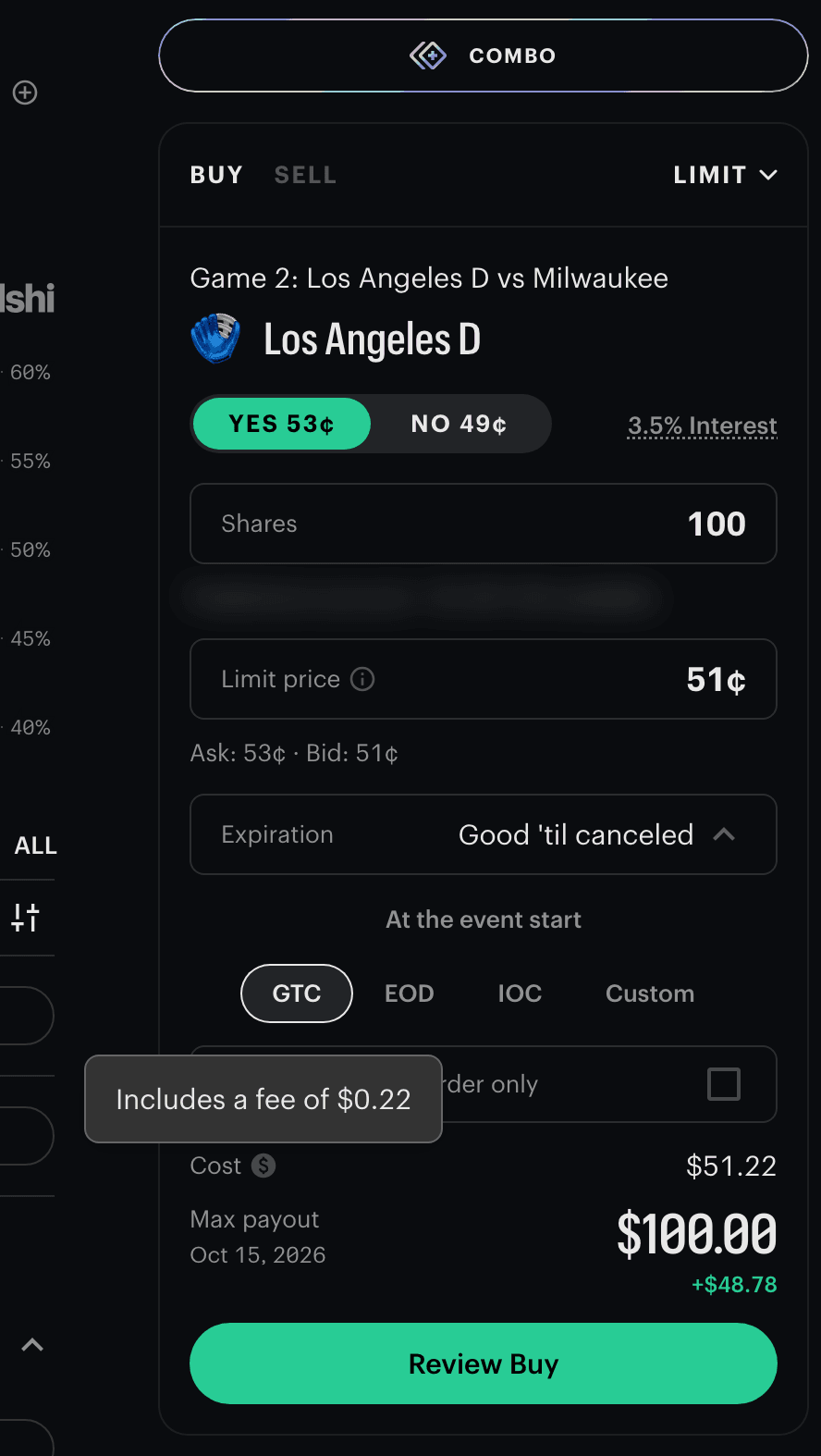
MLB game, resting at 51¢: $0.22
Expiration and IOC
How long an order waits.
Expiration sets how long a limit order can rest. One of its choices never rests at all.
- What it costs
Expiration changes how long an order can rest, not the fee on what fills. GTC rests until filled or canceled, EOD until 12AM EDT, and At the event start until the market begins: on the Nobel ticket it set 10/9/2026 · 5:00AM EDT. IOC, “Immediate or cancel”, takes what it can match when placed and cancels the rest, the standard meaning of immediate-or-cancel, so it never rests and whatever it fills, it fills as a taker; choosing it greys out Submit as resting order only. An order that expires unfilled costs nothing.
- How to place it
- With LIMIT chosen, open Expiration, which reads Good 'til canceled.
- Pick At the event start, or one of GTC, EOD, IOC and Custom.
- For Custom, set the Date and Time.
- The difference
An IOC at the 16¢ bid previews the same $16.00 as a resting order, but with nothing to match at 16¢ it would cancel unfilled. The preview does not show that. Kalshi’s API offers the same choices as good_till_canceled, with an optional expiration_time, immediate_or_cancel and fill_or_kill, plus a post_only flag.
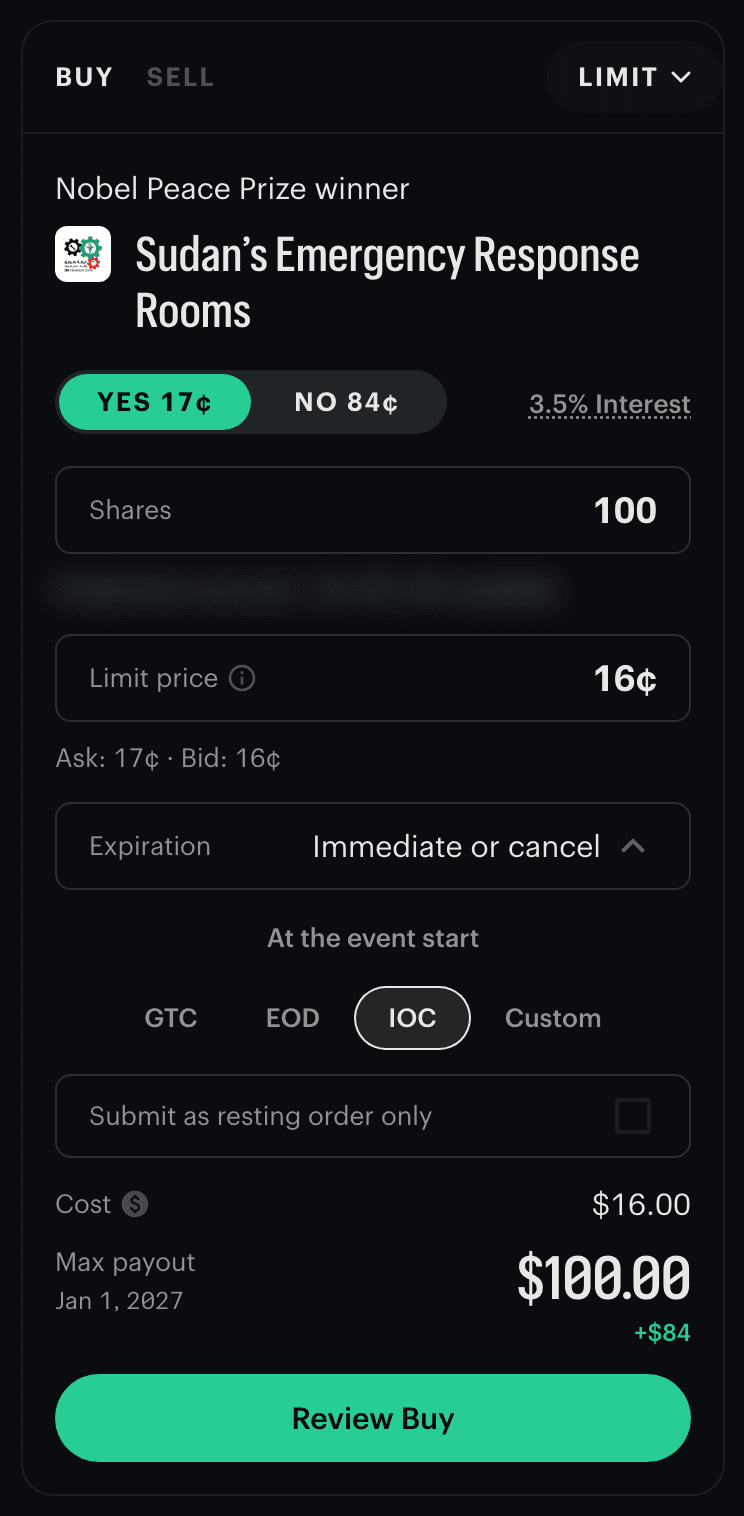
IOC selected
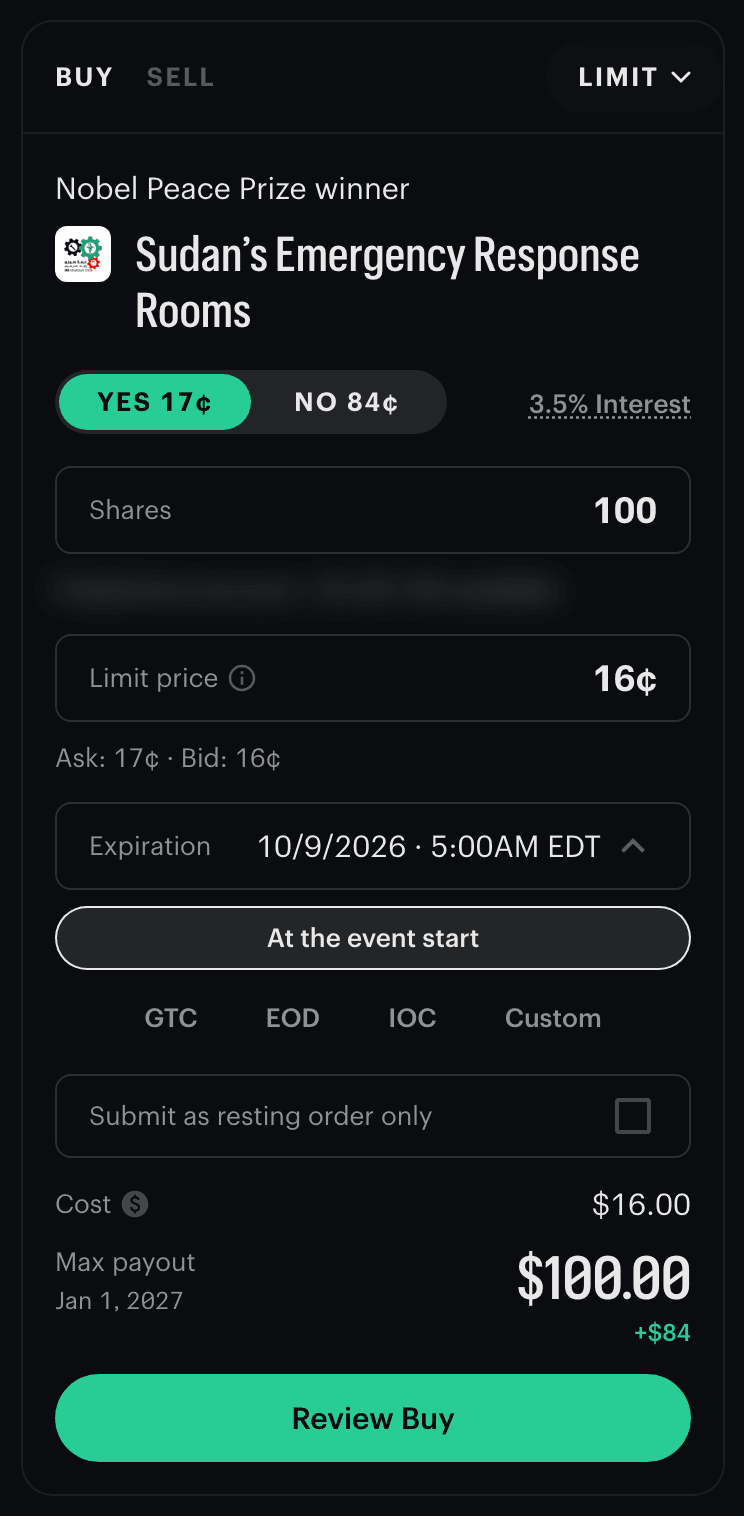
At the event start
- API orders
- good_till_canceled (optionally with an expiration_time), immediate_or_cancel or fill_or_kill, plus a post_only flag Source
Partial fills
When only part of an order matches.
An order can be a taker and a maker at once: the part that matches now takes, and the rest rests.
Kalshi’s help center describes a limit order larger than what is on offer at its price: it is “partially filled with the available contracts, and the remainder is listed on the order book”. The part that filled at once paid the taker fee. The remainder pays the maker fee if and when someone takes it, and Kalshi’s API reports the fee on each fill separately.
Say 60 of 100 contracts match at once at 50¢ in an NFL game and the other 40 fill later from the book: $1.05 on the 60 and $0.18 on the 40, $1.23 in all, against $1.75 had all 100 taken. In a market without maker fees the 40 pay nothing and the order costs $1.05.
Selling
Selling, or holding to settlement.
A sale is a trade like a purchase and pays the same fees. A position held until the market settles pays no second fee.
- What it costs
At the bid, the taker fee; resting at the ask, the maker fee. On a held NFL position, 100 contracts previewed Cash out $17.92 at the 19¢ bid, “Includes a fee of $1.08”, and $19.72 resting at the 20¢ ask, “Includes a fee of $0.28”.
- How to place it
- Open the market and choose SELL at the top of the ticket. It opens in SHARES with the whole position filled in.
- Choose LIMIT and enter Shares.
- Limit price is filled in with the bid, which sells at once. To rest instead, set it at or above the Ask and tick Submit as resting order only.
- Read Cash out, then Review Sell.
- The difference
$1.80 on 100 contracts: $1.00 of price and $0.80 of fee. Holding to settlement instead pays no exit fee at all, because Kalshi’s fee schedule says “There is no settlement fee.” At the tool’s defaults, 100 contracts bought at 40¢, a taker’s fees are $3.36 when sold at 60¢ and $1.68 when held to settlement. The contract then pays $1 or nothing.
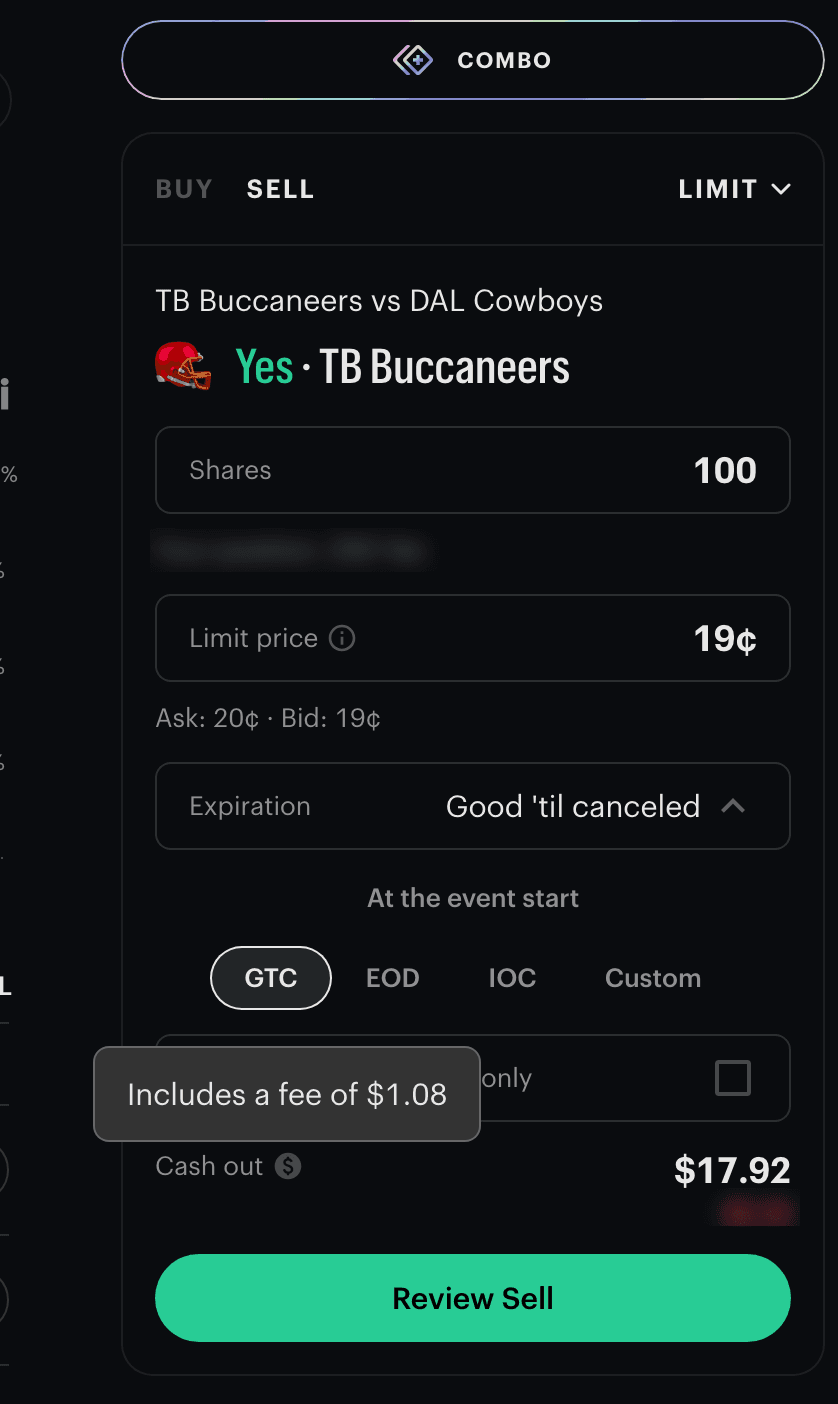
Selling at the 19¢ bid
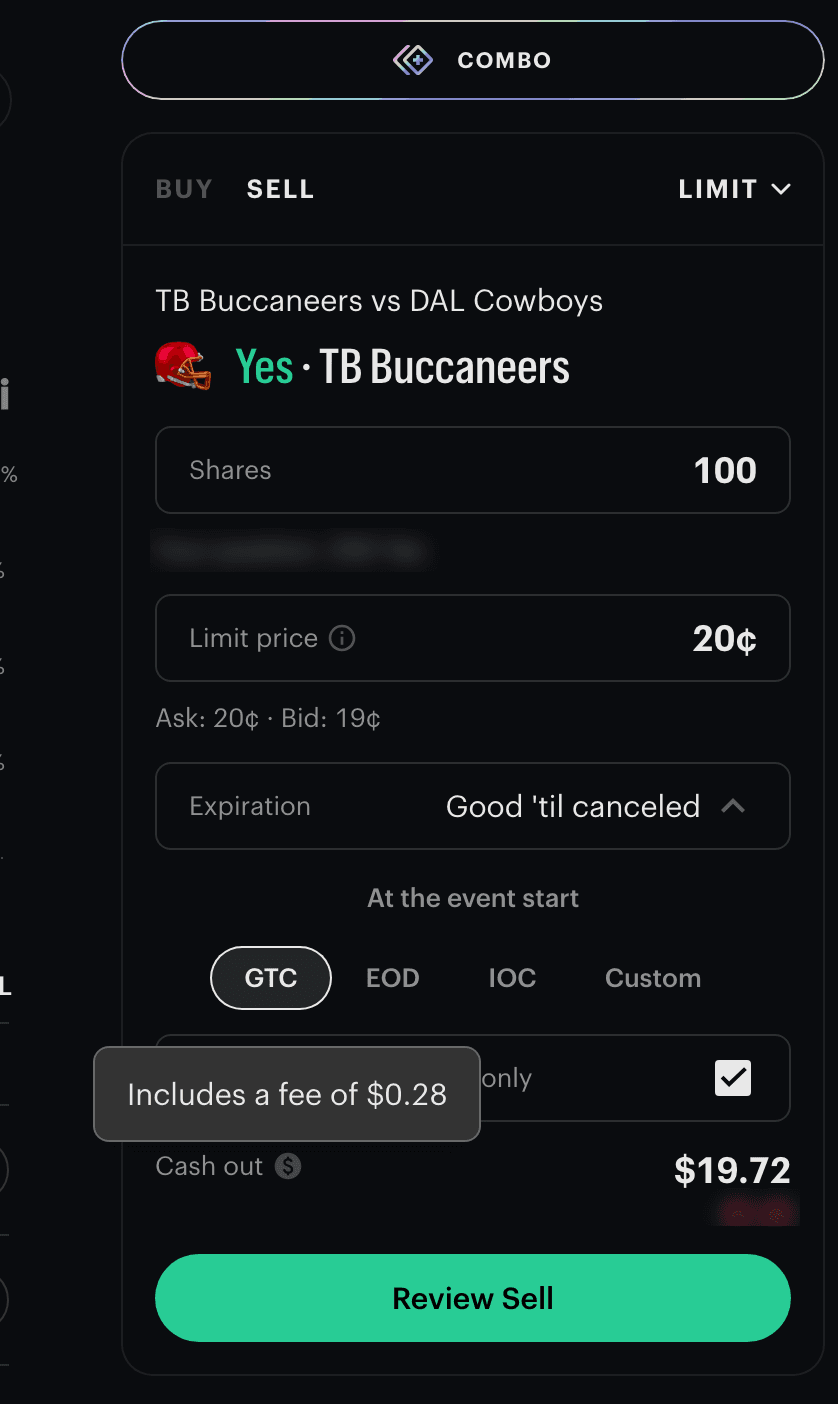
Resting at the 20¢ ask
Combos
Combos.
A combo’s ticket shows a quoted payout and no fee line.
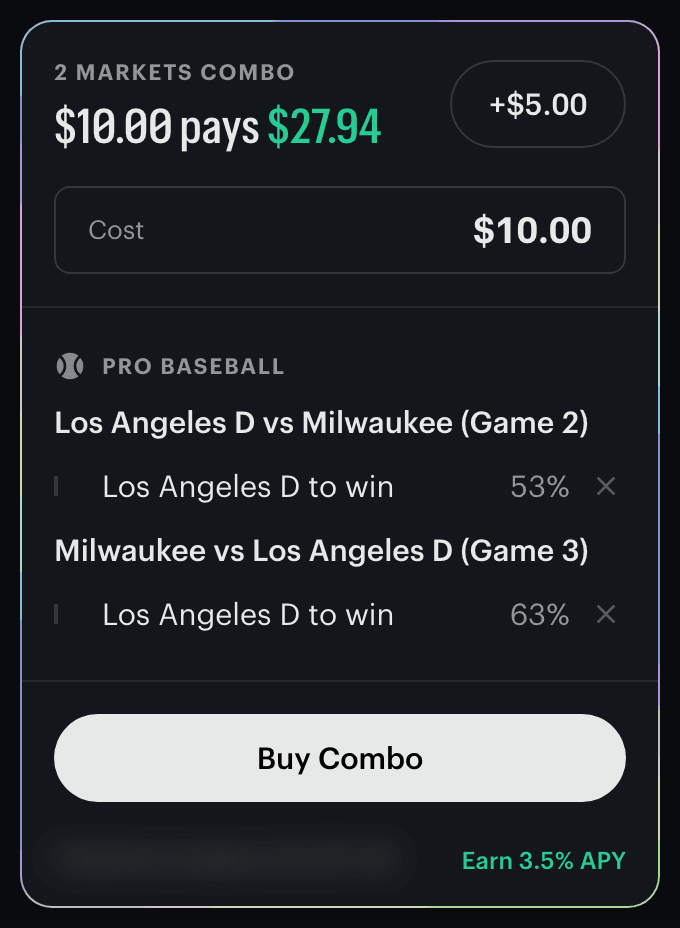
A combo starts from the COMBO button above a sports market’s ticket. As legs are picked, the page sends requests for quote (RFQ) behind the panel, and the panel shows the stake and the payout, “$10.00 pays $27.94” on two baseball legs, with a Cost line and Buy Combo. Nothing in it mentions a fee, a maker or a taker, so how much of the quoted payout is fee cannot be read off the ticket.
Kalshi’s fee schedule page sets the maker fee on combos at 50% of the taker fee, except uncorrelated NFL combos. The tool above leaves combos out, because a combo bought from the panel is priced by a quote, not by an order resting on a book.
Order size
How order size changes the rounding.
Each order’s fee rounds up to the cent, so many small orders pay more than one large one.
Kalshi rounds each order’s fee up so that the fee plus the position cost lands on a whole cent for most members, so a single contract at 50¢ pays 2¢ against a formula fee of 1.75¢. Split into 100 one-contract orders, 100 contracts at 50¢ pay $2.00 in fees; bought in one order they pay $1.75. The gap is widest at low prices, where the formula fee on one contract is a fraction of a cent.
| Price | 100 one-contract orders | One 100-contract order |
|---|---|---|
| 50¢ | $2.00 | $1.75 |
| 10¢ | $1.00 | $0.63 |
| 5¢ | $1.00 | $0.34 |
Deposits
What it costs to fund the account.
Not a trading fee, but money that does not reach a trade.
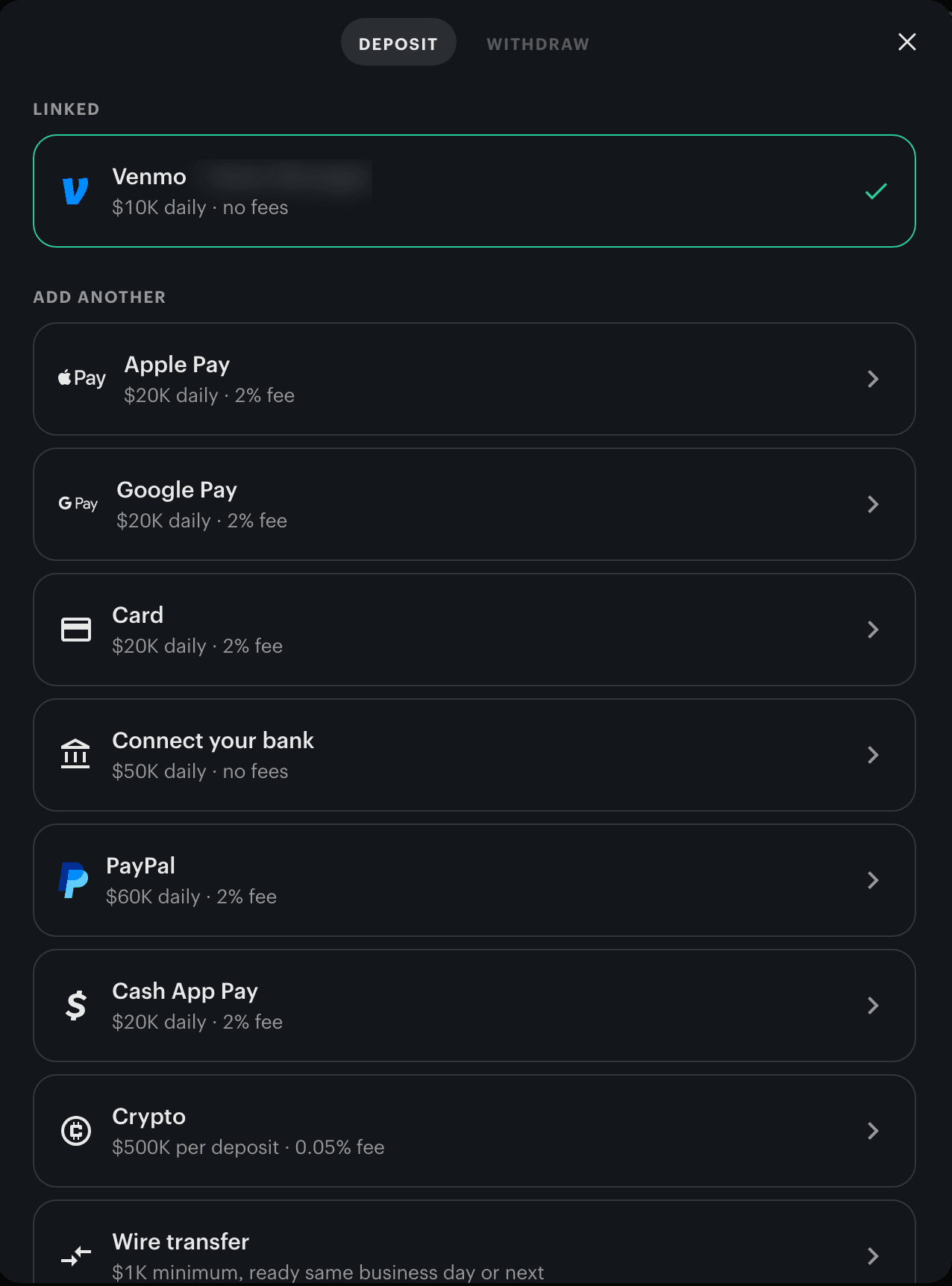
Kalshi’s deposit dialog lists each method with its limit and fee. Connect your bank shows “$50K daily · no fees”; Card, Apple Pay, Google Pay, PayPal and Cash App Pay show a 2% fee, $2.00 on a $100 deposit; crypto shows 0.05%. Kalshi’s fee schedule caps debit card deposits at 2% and reserves the right to charge 0% to 2% on any method. Fees on withdrawals are on Kalshi fees.
Rewards and discounts
Rewards for resting orders, and what earns no discount.
Kalshi pays some resting orders a reward. Volume, membership and cancelling do not change the fee.
Kalshi’s Liquidity Incentive Program pays rewards for resting orders in eligible markets, scored on their size and their distance from a reference price, “even if your orders don’t get filled”. Rewards run from $1 to $1,000 per market a day and arrive as credits, which sit beside the fee rather than lowering it. Kalshi reports more than $600 of incentive credits in a calendar year to the IRS (Kalshi tax forms).
For event contracts the fee schedule publishes no volume discount: its volume tiers are for perpetual futures. There is no membership fee to pay down, cancelling is already free, and the reduced fees designated market makers can receive come by agreement with Kalshi, not from a setting.
- Liquidity rewards
- Resting orders scored on size and distance from a reference price, filled or not; $1 to $1,000 per market a day, through January 1, 2027, unless Kalshi ends or changes it sooner Source
- Incentive credits
- More than $600 in a calendar year is reported to the IRS, and needs an SSN on file Source
- Perpetual futures
- Taker 12.0 to 2.6 bps and maker 5.0 to 0.6 bps, tiered by 30-day trailing perps plus prediction volume Source
- Market makers
- Designated market makers who meet quoting and volume requirements may receive reduced fees Source
Your records
How to see what each order paid.
Kalshi records the fee, and whether you took or made, on every fill.
The activity export from Your activity lists each fill as a Trade row with a Fee_In_Dollars column and an Order_Type column, which read Taker on the rows we checked. Kalshi’s API marks every fill is_taker and reports its fee_cost. Every column, and how to download each file, is on Kalshi data and exports; how fees sit inside a year’s net is on Kalshi taxes.
- Activity rows
- Orders, trades with their fee, and settlements with contracts held and profit; columns for deposits, withdrawals and credits Source
Questions
Questions people ask.
- Are limit orders free on Kalshi?
- A limit order that rests on the book and fills later pays no fee in most markets, because the maker multiplier in Kalshi’s fee schedule defaults to 0. Series with maker fees, such as NFL games, charge it a quarter of the taker fee, MLB game markets charge half the usual fee on both sides, and combos charge makers half the taker fee. A limit priced at the ask, or at the bid when selling, matches at once and pays the taker fee.
- Why did my Kalshi limit order pay a fee?
- Because it matched an order already on the book. The ticket fills in the limit price with the ask on a buy and the bid on a sale, so a limit order left at that price takes. On a Nobel Peace Prize market on October 8, 2026, 100 contracts at the prefilled 17¢ previewed $17.99, including $0.99 of fee; at the 16¢ bid they previewed $16.00 with no fee.
- What does “Submit as resting order only” do on Kalshi?
- It stops a limit order from matching at once. With the box ticked and the price at the ask, the ticket shows “Resting orders can't exceed the bid price. Change your price or turn off resting order only.” and the Review Buy button is disabled until the price comes down or the box is cleared. Kalshi’s API has a similar post_only flag.
- Does Kalshi charge a fee to settle or cancel an order?
- No. Kalshi’s fee schedule says there is no settlement fee, and that cancelling a resting order costs nothing. A position held until it settles pays only the fee on the order that opened it.
- Do Kalshi sports markets charge maker fees?
- Some do. NFL game markets (KXNFLGAME) list a maker multiplier of 1: 100 contracts resting at 55¢ previewed a $0.44 fee, against $1.73 to buy at the 56¢ ask. MLB game markets (KXMLBGAME) have carried a multiplier of 0.5 on both sides since August 7, 2026: $0.22 resting at 51¢ and $0.88 taking at 53¢. Kalshi’s fee schedule page lists every series with its own multipliers.
- Do Dollars and Shares orders cost more than a limit order on Kalshi?
- Not at the same price. DOLLARS and SHARES buy from orders already on the book, so they pay the taker fee, and so does a limit order at the ask. 100 contracts at 17¢ previewed $17.99 in SHARES and in LIMIT alike. Only a limit priced below the ask, which rests until a seller meets it, pays the maker fee.
Sources13 documents
Where each fact comes from.
Every figure above links to one of these, read on the date shown.
- Kalshi Fee Schedule (PDF), effective July 7, 2026 Checked October 8, 2026
- Kalshi order ticket, Nobel Peace Prize market (signed in) Checked October 8, 2026
- Kalshi API docs: Get Series Fee Changes (KXMLBGAME) Checked October 8, 2026
- Kalshi: Fee schedule Checked October 8, 2026
- Kalshi Help Center: Limit orders Checked October 8, 2026
- Kalshi API docs: Create Order (V2) Checked October 8, 2026
- Kalshi API docs: Get Fills Checked October 8, 2026
- Kalshi combo ticket, pro baseball (signed in) Checked October 8, 2026
- Kalshi account: Deposit dialog (signed in) Checked October 8, 2026
- Kalshi Help Center: Liquidity Incentive Program Checked October 8, 2026
- Kalshi Help Center: How to add your Social Security Number Checked October 8, 2026
- Kalshi Help Center: How to become a market maker on Kalshi Checked October 8, 2026
- Kalshi account: Your activity (signed in) Checked October 8, 2026
Also on Realize
The rest of the Kalshi record.
The fee formula, the records Kalshi keeps, and how its trades are taxed.
Price your Kalshi year three common ways.
Connect Kalshi read-only for a free estimate under each treatment.