KalshiRobinhoodCompare
Kalshi and Robinhood, side by side on forms, records and fees.
Robinhood’s prediction markets are event contracts sold through a broker, Robinhood Derivatives, which names Kalshi as one of four exchanges behind them. As of October 9, 2026, Robinhood sends no 1099 for those trades and calls its annual statement “not a substitute tax reporting form”. Kalshi sends 1099s for interest, credits and crypto, none showing trading profit or loss. On 100 contracts at 50¢, a Kalshi taker pays $1.75; through Robinhood the same contract costs $2.00 in fees.
By Owen Monagan, Founder & CEOUpdated From each firm’s own documents
Side by side
Checked October 9, 2026- Robinhood exchanges
- KalshiEX LLCForecastEX, LLCRothera Exchange and Clearing LLCNorth American Derivatives Exchange, Inc. Source
Which exchange
Does Robinhood use Kalshi?
Yes, and three other exchanges, by Robinhood’s own disclosure.
The disclosure at the foot of every Robinhood event contract help article reads: “Event contracts are offered by Robinhood Derivatives, LLC through either KalshiEX LLC, ForecastEX, LLC or Rothera Exchange and Clearing LLC, or North American Derivatives Exchange, Inc.” Robinhood Derivatives is a futures commission merchant registered with the CFTC and a member of the NFA, and its overview says it reaches those exchanges through “its membership with the partnered exchanges”.
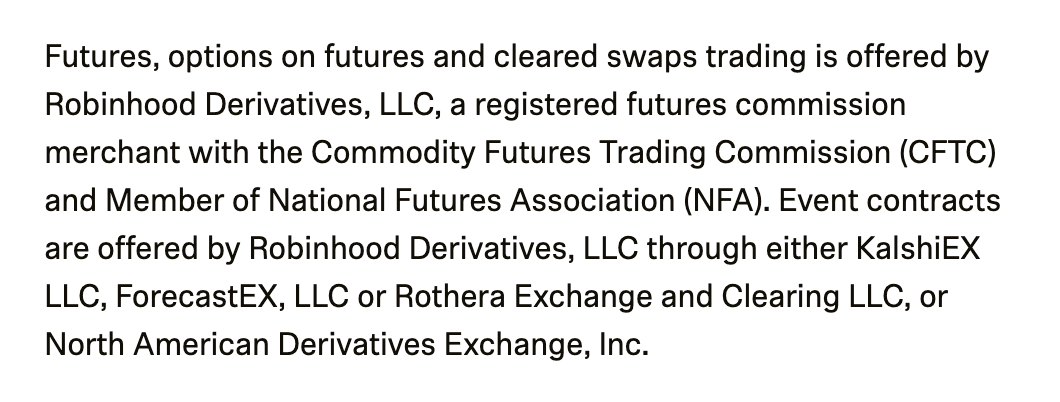
So a Robinhood prediction market trade is not always a Kalshi trade. None of the event contract help articles says how to tell which exchange a given contract trades on. Kalshi, by contrast, is the exchange: KalshiEX LLC, which the CFTC designated a contract market on November 4, 2020, and an account there is an account with the exchange itself.
Robinhood trades are placed in its mobile app; the web shows prediction markets but cannot trade them. Robinhood lists its own state limits, and they are not Kalshi’s; where Kalshi is restricted is set out in Is Kalshi legal in my state?
- Exchanges
- KalshiEX LLCForecastEX, LLCRothera Exchange and Clearing LLCNorth American Derivatives Exchange, Inc. Source
- How it reaches them
- Through Robinhood Derivatives and its membership with the partnered exchanges Source
- Where you trade
- The Robinhood mobile app; the web shows prediction markets but cannot trade them Source
Side by side
Kalshi vs Robinhood, row by row.
Kalshi’s column is the exchange’s own help center and fee schedule; Robinhood’s is its help center and Robinhood Derivatives fee schedule.
| Kalshi | Robinhood | |
|---|---|---|
| Your account is with | KalshiEX LLC, the exchange | Robinhood Derivatives, LLC, a broker |
| Registration | A contract market by the CFTC on November 4, 2020 | A futures commission merchant registered with the CFTC, and a member of the NFA |
| Exchanges behind the contracts | KalshiEX LLC | KalshiEX LLC, ForecastEX, LLC, Rothera Exchange and Clearing LLC, North American Derivatives Exchange, Inc. |
| Tax forms | 1099-INT, 1099-MISC, 1099-B, 1099-DA | No 1099 for event contract trades |
| Trading profit or loss on a form | No form reports it | No 1099 for event contract trades |
| Reported to the IRS | Not your profits or losses: “Kalshi does not report profits/losses to the IRS” | No: “Event contract trades aren’t reported to the IRS by Robinhood” |
| Year-end record | Yearly, first in first out; the help center says it updates the first morning of each month | Typically late January or early February: each trade, closing dates, costs, proceeds, fees and commissions, net P&L |
| Trade history | Your activity page: All time to Custom dates, saving Kalshi-Recent-Activity-All.csv with 25 columns of orders, trades, settlements, deposits, withdrawals and credits | Account, History, filtered to Event contracts: every trade, payout and fee, in the app |
| Fees in the profit and loss | Its profit and loss figure includes fees and any rebates | Investing, Realized profit & loss, Prediction markets; “this view doesn’t include fees” |
| Fee on a trade | round up(M x 0.07 x C x P x (1-P)) | Commission k x p x (1 - p) x c, k = 10% (5% with Gold), rounded up to $0.01, at most $0.01 a contract |
| Exchange fee | None on top of the fee above | $0.01 per contract, per side on Kalshi contracts |
| Settlement | No fee | No settlement fee listed |
Tax forms
Does Robinhood or Kalshi send a 1099?
Neither Robinhood nor Kalshi puts your trading profit or loss on a form, for different reasons.
The difference starts with who holds the account. On Kalshi it is the exchange. On Robinhood it is the broker, Robinhood Derivatives, and each firm sets its own tax-reporting policy for the accounts it holds. Kalshi’s own fee schedule allows for the broker route: users reaching Kalshi through a third-party futures commission merchant “may be charged fees by their Futures Commission Merchant that vary from the above fee schedule”.
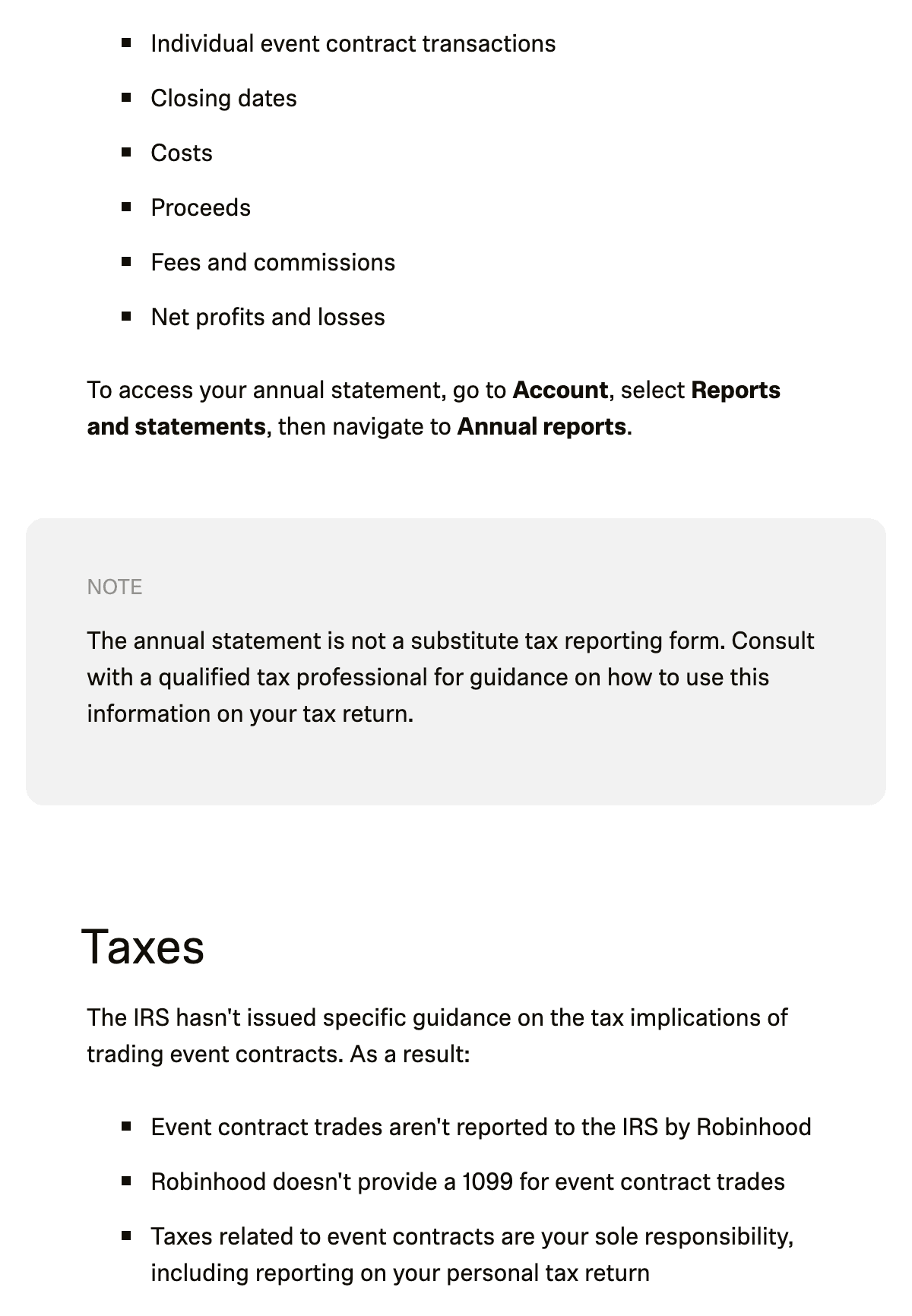
Robinhood’s tax article is short: “Event contract trades aren’t reported to the IRS by Robinhood”, “Robinhood doesn’t provide a 1099 for event contract trades”, and “Taxes related to event contracts are your sole responsibility”.
The consolidated 1099 that Robinhood Markets sends can carry a Section 1256 section on its 1099-B. Robinhood describes that section as reporting regulated futures contracts and non-equity options. Event contract trades are not on it: Robinhood provides no 1099 for them.
Kalshi sends more forms and still none with the trading result. Its tax documentation article lists a 1099-INT for interest, a 1099-MISC for credits and rewards, a 1099-B for crypto transfers and a 1099-DA from ZeroHash, and its Documents page says “Kalshi does not report profits/losses to the IRS”. Kalshi tax forms gives each form’s threshold.
On either app, then, the year’s trading result comes from your own records, whether or not a form reports it: gross income means “all income from whatever source derived” (IRC §61). There is no IRS guidance on how event contracts are taxed; Kalshi taxes works one year through the three routes people most often file under.
- Consolidated 1099
- One PDF from Robinhood Markets, Inc., which can include a 1099-B Section 1256 section for regulated futures; due February 17, 2026 for tax year 2025 Source
Year-end records
What year-end record does each give you?
Kalshi’s downloads are there whenever you ask. Robinhood’s statement arrives after the year closes.
Robinhood sends an event contracts annual statement “typically in late January or early February”, under Account, Reports and statements, Annual reports. It lists each transaction, closing dates, costs, proceeds, fees and commissions, and net profit and loss. Robinhood calls it “the authoritative record of all costs, proceeds, and net P&L for the year”, and in the same article says it “is not a substitute tax reporting form”.
Before the statement, the app has two views. Realized profit & loss, filtered to Prediction markets, shows results by period, and Robinhood notes “this view doesn’t include fees” and that its totals may not match the statement “due to the timing of settlements”. Account, History, filtered to Event contracts, shows every trade, payout and fee.
Kalshi’s records are downloads you can pull at any point in the year. The yearly profit and loss file is first in, first out, includes fees and any rebates, and the 2026 file downloaded on October 8, 2026 already held closes from that morning. The activity CSV covers orders, trades, settlements, deposits, withdrawals and credits for any date range, and the API reports the fee on every fill. Kalshi trade history covers the columns.
Someone trading on both has two records that may describe the same exchange: Kalshi contracts bought through Robinhood sit in Robinhood’s history and statement, not in a Kalshi account’s downloads.
- Annual statement
- Typically late January or early February: each trade, closing dates, costs, proceeds, fees and commissions, net P&L Source
- What the statement is
- “The authoritative record of all costs, proceeds, and net P&L for the year” Source
- In-app realized P&L
- Investing, Realized profit & loss, Prediction markets; “this view doesn’t include fees” Source
- Trade history
- Account, History, filtered to Event contracts: every trade, payout and fee, in the app Source
Fees
What are Robinhood’s prediction market fees?
Two layers on each trade, a commission and an exchange fee: $2.00 on 100 Kalshi contracts at 50¢ and $1.90 at 10¢, against $1.75 and $0.63 for a taker on Kalshi directly.
Since June 1, 2026, Robinhood’s commission is k x p x (1 - p) x c, with k at 10%, or 5% with Robinhood Gold at $5 a month, rounded up to the cent “with a maximum commission rate of $0.01 per contract”. On top of it sits an exchange fee: the overview says it “can be up to $0.01 per contract”, and the Robinhood Derivatives fee schedule sets it for Kalshi contracts at “$.01 per contract, per side”. Both apply to opening and closing trades. Robinhood’s own worked example, 100 contracts at 90¢ without Gold, comes to a$0.90 commission plus a $1.00 exchange fee, a total cost of $91.90.
Trading on Kalshi directly, a taker pays round up(M x 0.07 x C x P x (1-P)), where C is the contract count, P the price in dollars and M a multiplier that is 1 for takers in most markets; a resting order there pays nothing. Kalshi fees covers the schedule and its exceptions.
| Price | Kalshi direct, taker | Robinhood commission | Exchange fee via Robinhood | Robinhood total |
|---|---|---|---|---|
| 1¢ | $0.07 | $0.10 (Gold $0.05) | $1.00 | $1.10 (Gold $1.05) |
| 10¢ | $0.63 | $0.90 (Gold $0.45) | $1.00 | $1.90 (Gold $1.45) |
| 25¢ | $1.32 | $1.00 (Gold $0.94) | $1.00 | $2.00 (Gold $1.94) |
| 50¢ | $1.75 | $1.00 (Gold $1.00) | $1.00 | $2.00 (Gold $2.00) |
| 75¢ | $1.32 | $1.00 (Gold $0.94) | $1.00 | $2.00 (Gold $1.94) |
| 90¢ | $0.63 | $0.90 (Gold $0.45) | $1.00 | $1.90 (Gold $1.45) |
| 99¢ | $0.07 | $0.10 (Gold $0.05) | $1.00 | $1.10 (Gold $1.05) |
Robinhood’s documents do not agree on the commission. The overview and its table apply the formula and the cap. The tax article still says “Robinhood charges $0.01 per contract and exchanges typically charge ~$0.01 per contract”, and the fee schedule gives the formula without the cap. The table above follows the overview, whose own table it matches.
- Commission
- k x p x (1 - p) x c, k = 10% (5% with Gold), rounded up to $0.01, at most $0.01 a contract Source
- Fee wording in the tax article
- “Robinhood charges $0.01 per contract and exchanges typically charge ~$0.01 per contract” Source
- Commission cap in the fee schedule
- Not stated; the overview article and its table carry the $0.01 cap Source
Questions
Questions people ask.
- Does Robinhood use Kalshi?
- Yes, and three other exchanges. Robinhood’s disclosure says its event contracts are offered by Robinhood Derivatives, LLC “through either KalshiEX LLC, ForecastEX, LLC or Rothera Exchange and Clearing LLC, or North American Derivatives Exchange, Inc.” Its event contract help articles do not say how to tell which of the four a given trade went to.
- Does Robinhood send a 1099 for prediction markets?
- No. Robinhood’s tax article says “Robinhood doesn’t provide a 1099 for event contract trades” and that those trades “aren’t reported to the IRS by Robinhood”. It sends an annual statement after year end, typically in late January or early February, and says the statement “is not a substitute tax reporting form”.
- What 1099s does Kalshi send?
- Up to four, each only once an IRS threshold is crossed: a 1099-INT for interest, a 1099-MISC for credits and rewards, a 1099-B for crypto transfers and a 1099-DA from ZeroHash. Profit or loss on event contracts is on none of them, so on Kalshi too the trading figure comes from your own records.
- How do Robinhood’s prediction market fees compare with Kalshi’s?
- They are built differently. Kalshi charges a taker 0.07 x C x P x (1-P), rounded up: $1.75 on 100 contracts at 50¢ and $0.63 at 10¢. Robinhood charges a commission of 10% x p x (1 - p) per contract, capped at $0.01, plus an exchange fee its fee schedule sets at $0.01 per contract on Kalshi contracts: $2.00 on 100 at 50¢ and $1.90 at 10¢, or $1.45 at 10¢ with Gold. Robinhood’s charges apply to opening and closing trades.
- Can I trade Kalshi markets on Robinhood in Maryland?
- Robinhood’s own articles word it two ways on October 9, 2026: its restrictions article says Maryland residents can’t trade event contracts, and its overview says Maryland residents can’t trade sports event contracts. Robinhood says to check the app for the current list. Where Kalshi itself is restricted follows court and regulator orders, covered state by state on Is Kalshi legal in my state?
Sources13 documents
Where each fact comes from.
Every figure above links to one of these, read on the date shown.
- Robinhood Help Center: Trading event contracts Checked October 9, 2026
- Robinhood Help Center: Event contracts overview Checked October 9, 2026
- Robinhood Help Center: Event contract taxes, reports, and statements Checked October 9, 2026
- Robinhood Help Center: Taxes and forms Checked October 9, 2026
- Robinhood Derivatives Standard Pricing Fee Schedule (PDF) Checked October 9, 2026
- Robinhood Help Center: Event contract restrictions Checked October 9, 2026
- CFTC Designates KalshiEX LLC as a Contract Market Checked October 8, 2026
- Kalshi Help Center: What tax documentation does Kalshi provide? Checked October 8, 2026
- Kalshi account Documents page (logged in) Checked October 8, 2026
- Kalshi account: Your activity (signed in) Checked October 8, 2026
- Kalshi API docs: Get Fills Checked October 8, 2026
- Kalshi Fee Schedule (PDF), effective July 7, 2026 Checked October 8, 2026
- IRC §61, gross income defined (Cornell LII) Checked October 9, 2026
Also on Realize
The rest of the Kalshi record.
Forms, fees and downloads in depth, and the other exchange people compare Kalshi with.
Price your Kalshi year three common ways.
Connect Kalshi read-only for a free estimate under each treatment.